Who is the True Father and Mother of Brahma, Vishnu, and Shiva
Find Answers / Who is the True Father and Mother of Brahma, Vishnu, and Shiva
Who is the True Father and Mother of Brahma, Vishnu, and Shiva
The Cosmic Lineage: Unveiling the True Father and Mother of Brahma, Vishnu, and Shiva
A foundational question within Puranic theology concerns the lineage of the Trimurti—Lord Brahma (the Creator), Lord Vishnu (the Preserver), and Lord Shiva (the Destroyer). While popular folklore often portrays these three deities as self-existent or without birth, a deep dive into the core scriptural evidence reveals a definitive lineage.
By combining the structural testimony of the Shiva Purana (Rudra Samhita) with the complimentary declarations found in the Shrimad Devi Bhagwat Purana, we arrive at an unshakeable, cross-referenced conclusion: The ultimate cosmic mother of the Trinity is Goddess Durga (Prakriti/Jagadamba), and their supreme cosmic father is Lord Sadashiva (Kaal-Brahm).
Part 1: Evidence From the Shiva Purana (Rudra Samhita)
The Shiva Purana, specifically within Chapter 6 of the Rudra Samhita, lays out the sequential chronological history of how the universe was generated and how the Trimurti came into existence.
1. The Pre-Creation State and Manifestation of the Father
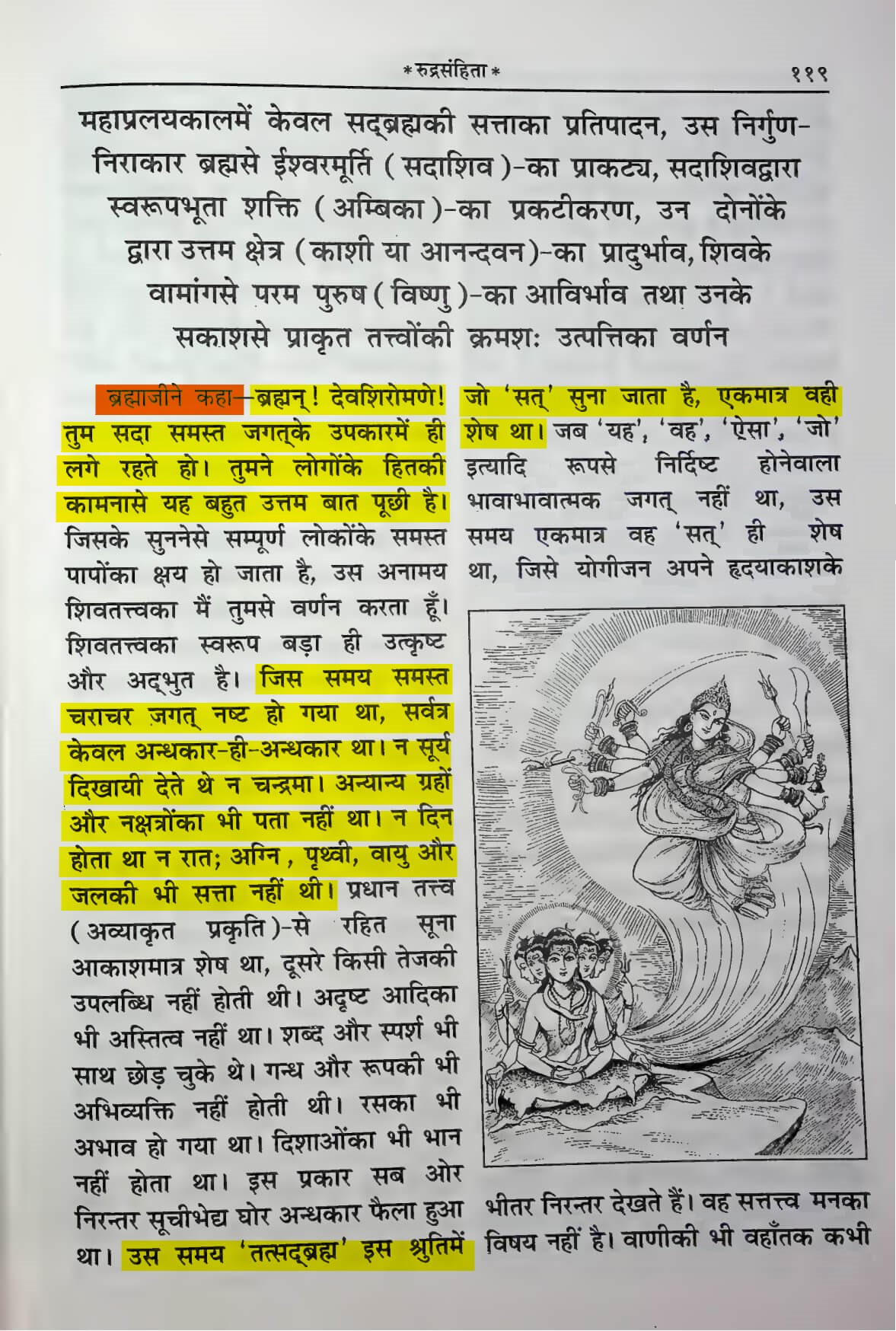
Before the dawn of creation, the cosmos existed in a state of absolute dissolution (Mahapralaya). According to shiv-purana-rudrasamhita-page119.jpg, there was nothing but a dense, pitch-black void—devoid of elements, celestial bodies, or time. The only entity in existence was the formless, qualityless absolute reality referred to as Tat Sadbrahm.
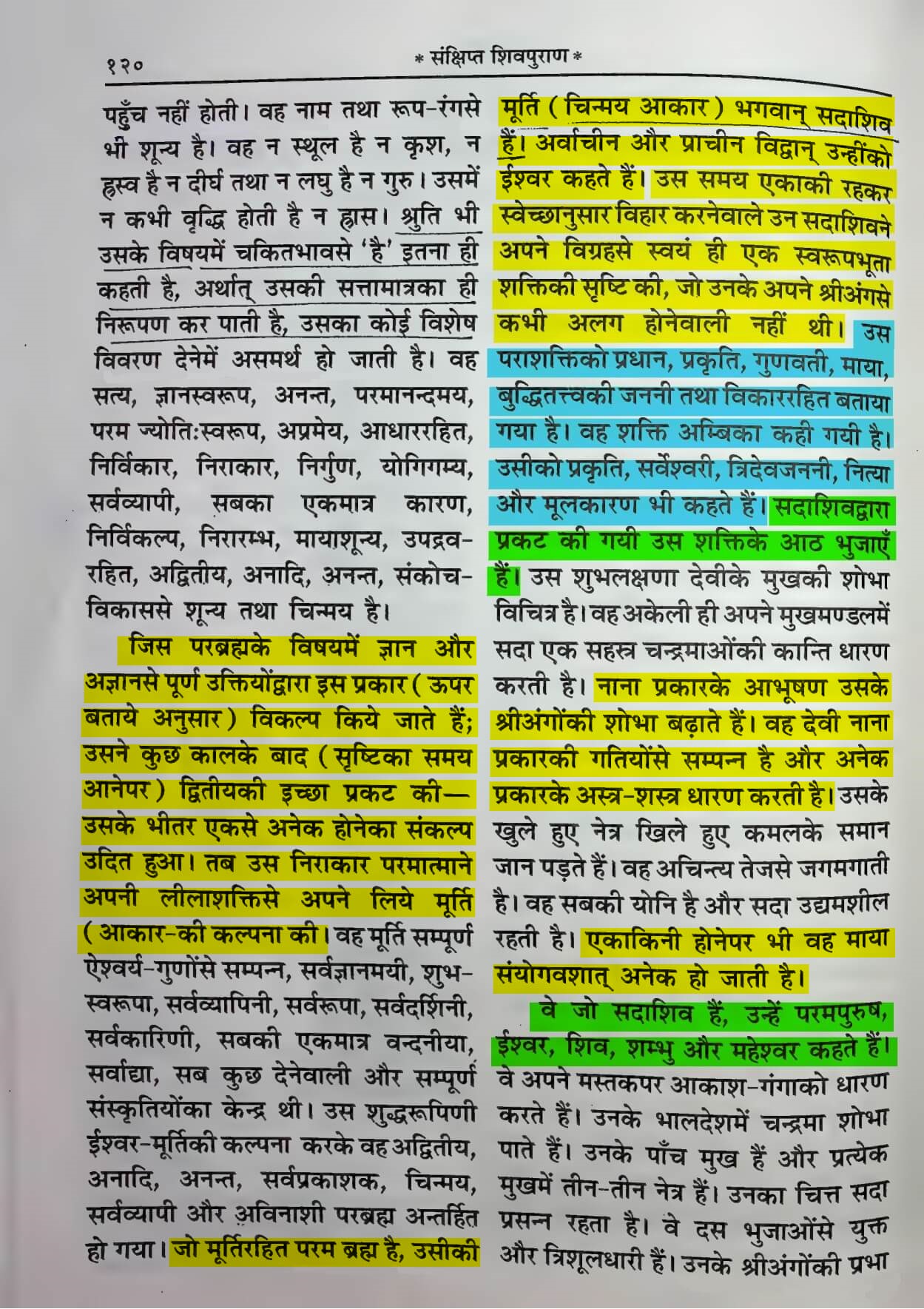
To initiate cosmic play, this formless reality took a conscious, all-pervading form. As documented in shiv-purana-rudrasamhita-page120.jpg, this manifested conscious physical form is Lord Sadashiva, whom ancient and modern scholars call Isvara, Paramapurusha, and Maheshvara. He serves as the primordial masculine principle (Father).
2. The Separation of the Mother (Goddess Durga)
Lord Sadashiva then generated a supreme feminine power directly from his own physical body without diminishing his own self. shiv-purana-rudrasamhita-page120.jpg explicitly names this goddess:
"She is called Parashakti, Pradhan Prakriti, Gunavati, Maya, Buddhitattva's mother, and Ambika."
The text highlights that this specific manifestation of Shakti possesses eight arms (Ashta Bhujaen). This matches the description of Goddess Durga. She is explicitly crowned as the Tridevjanani—the Mother of the Trinity.
3. The Birth of Lord Vishnu
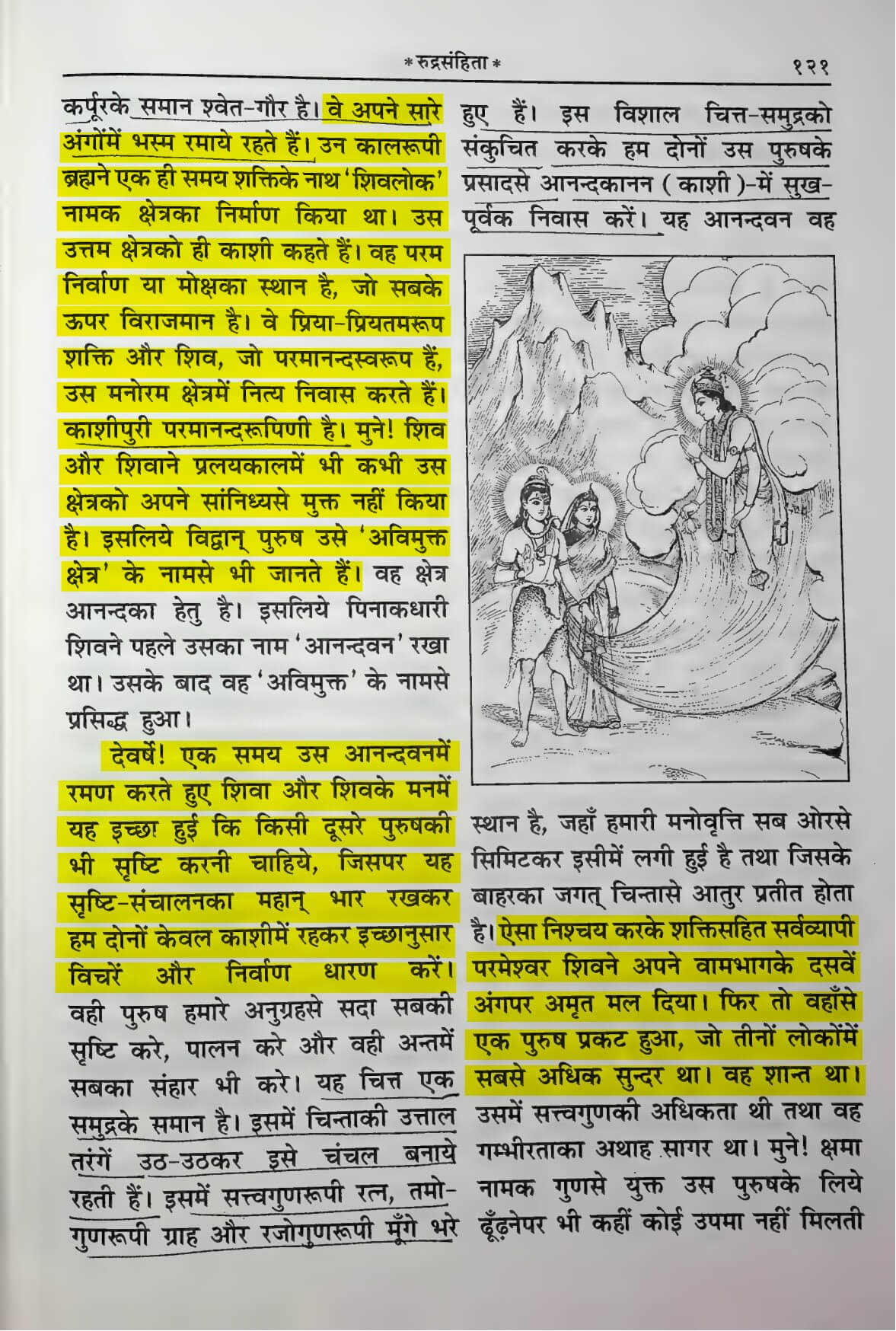
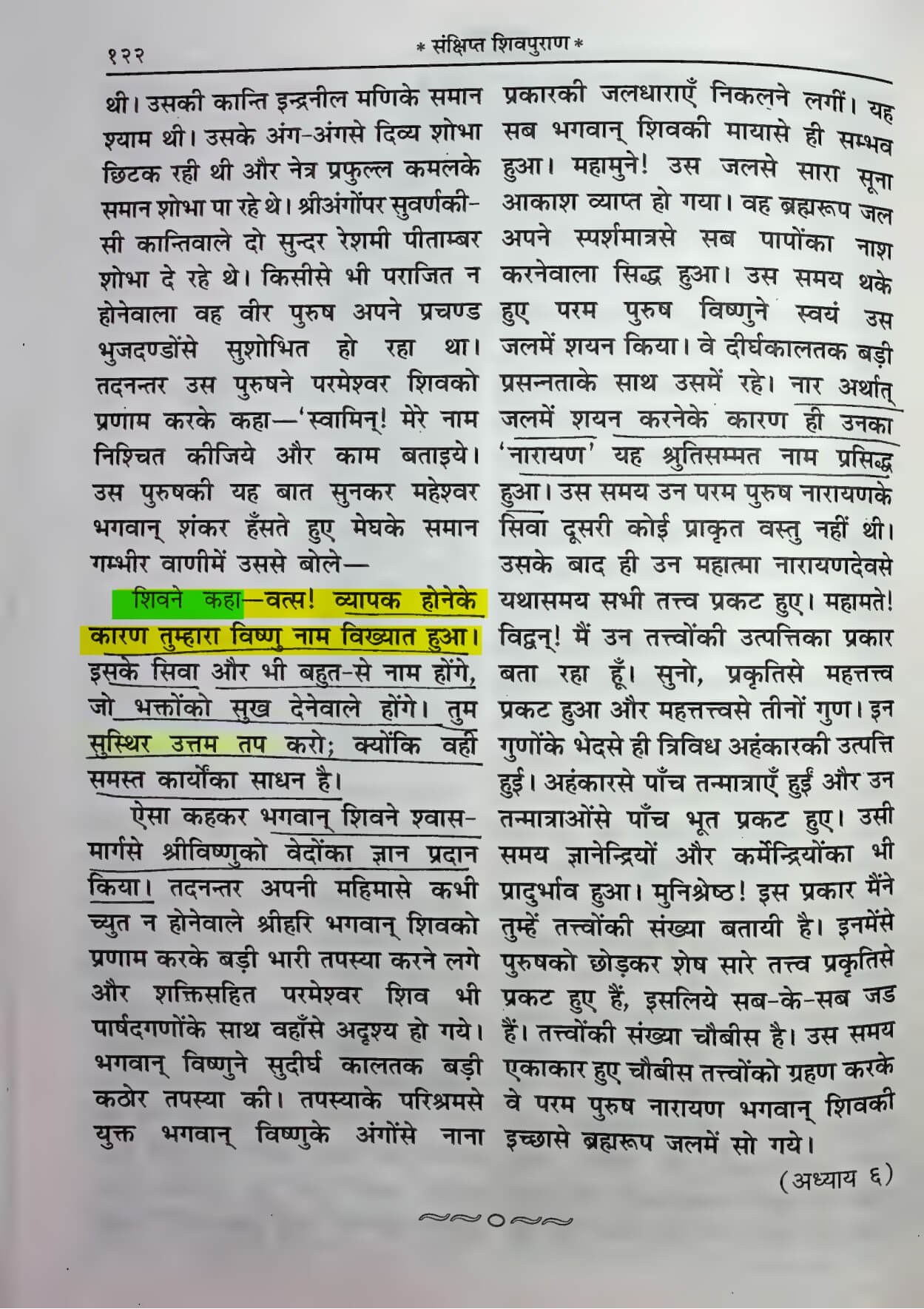
As the divine couple resided in their eternal abode of Kashi, they determined that an entity must be created to look after the preservation of the upcoming worlds. As recorded in shiv-purana-rudrasamhita-page121.jpg and shiv-purana-rudrasamhita-page122.jpg, Lord Sadashiva spread a nectar-like substance on his left side, and from it materialized Lord Vishnu, who was then blessed and given the knowledge of the Vedas by Sadashiva.
4. The Birth of Lord Brahma
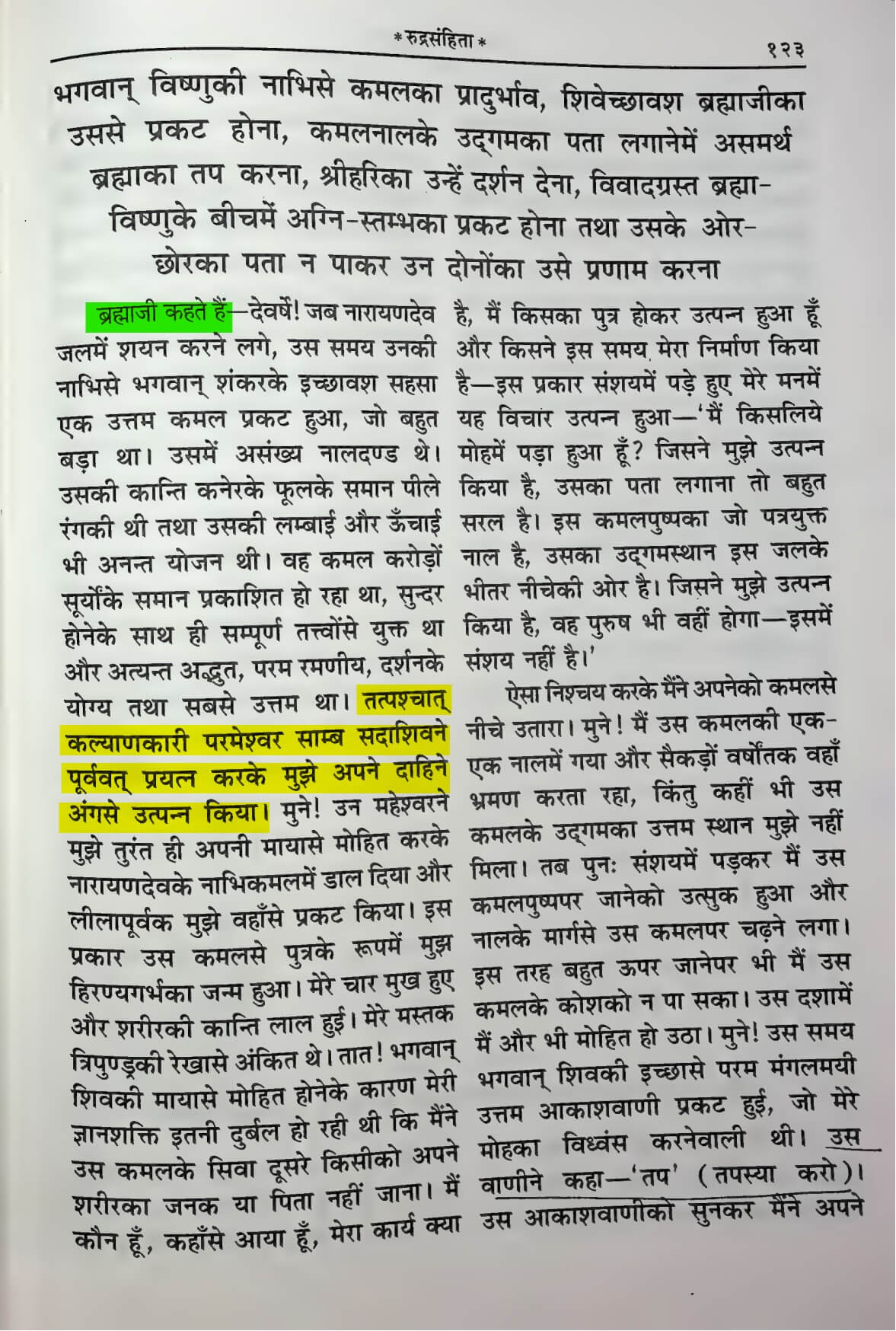
Following the creation of Vishnu, Sadashiva exerted his creative power on his right side. In shiv-purana-rudrasamhita-page123.jpg, Lord Brahma himself describes his origin story to Sage Narada:
"Thereafter, the benevolent Parameshvar Sadashiva (Kaal-Brahm)... created me from his right limb."
Thus, the Shiva Purana sets up a clear, undeniable lineage: Lord Sadashiva is the Father, Goddess Durga (Ambika/Prakriti) is the Mother, and the Trinity are their progeny.
Part 2: Evidence From the Shrimad Devi Bhagwat Purana
The Shrimad Devi Bhagwat Purana complements the Shiva Purana, providing testimony directly from the mouths of the Trimurti themselves regarding their parentage and dependence on the primordial Mother.
1. Lord Vishnu’s Personal Eyewitness Account
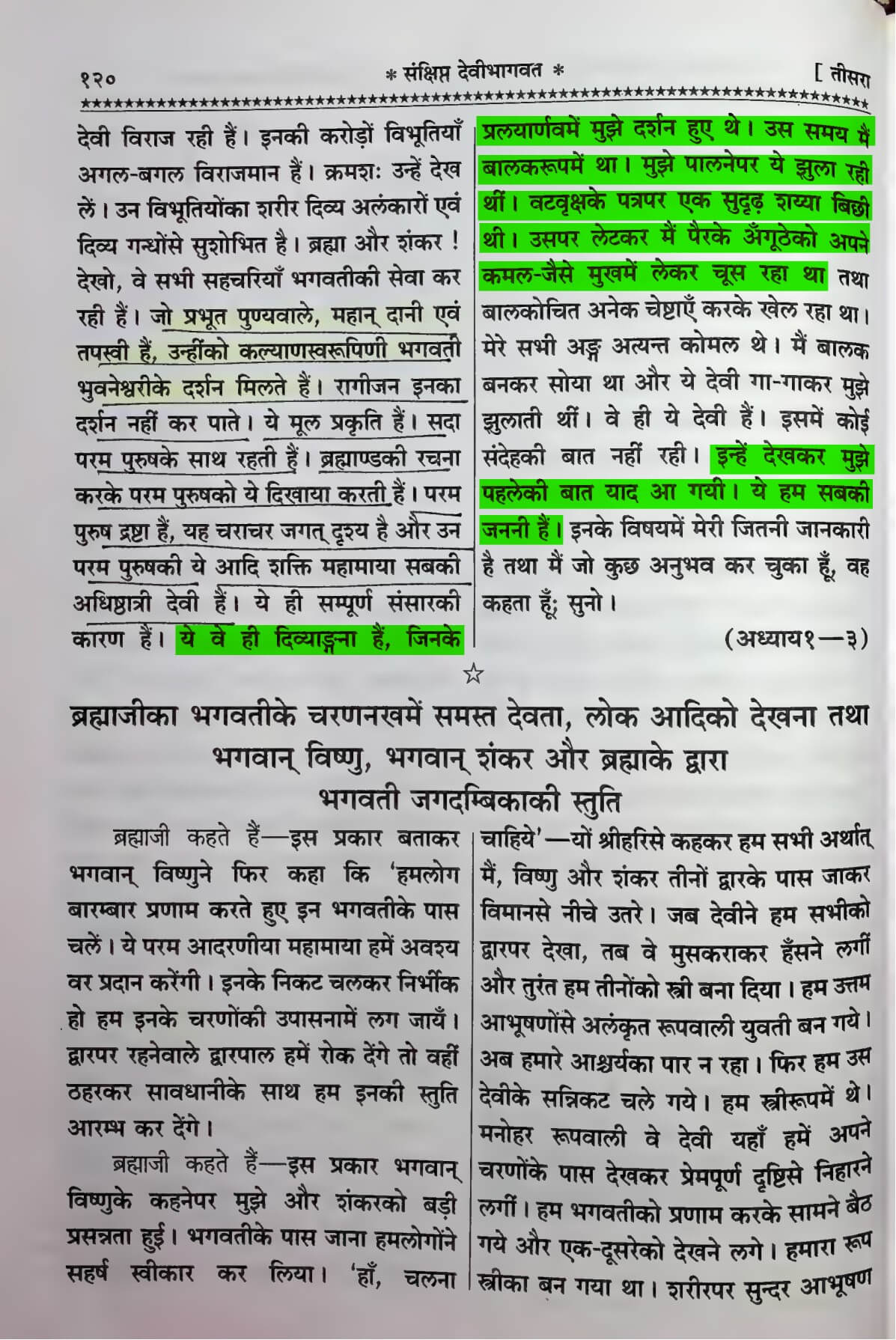
In shrimad-devi-bhagwat-page120.jpg, Lord Vishnu recounts his earliest memories during the cosmic ocean state (Pralyarnavam). Vishnu states that when he was a small infant lying upon a banyan leaf, it was the supreme Goddess who watched over him and gently rocked his cradle.
Looking upon her divine form, Lord Vishnu openly proclaims:
"She is the mother of us all. There is no doubt in this matter."
2. Lord Brahma Identifies the Primordial Nature
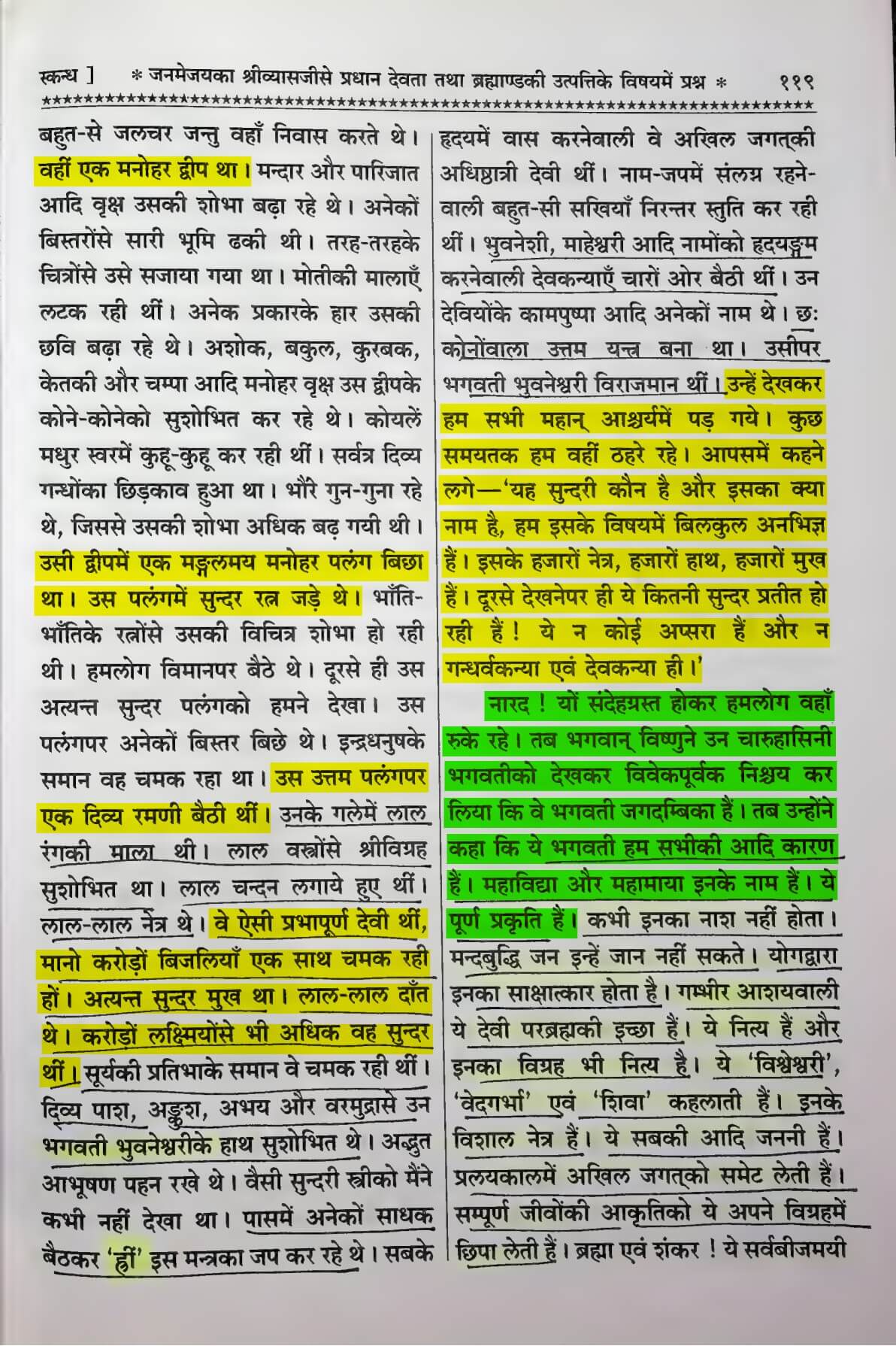
In shrimad-devi-bhagwat-page119.jpg, Lord Brahma and Lord Vishnu encounter the supreme Goddess seated upon a divine bedstead on a celestial island. After using discrimination and wisdom, Lord Vishnu identifies her true cosmic station:
- She is recognized explicitly as Bhagavati Jagadambika (The Mother of the World).
- She is called Mahavidya, Mahamaya, and Purna Prakriti (The Complete Primordial Nature/Durga).
- The text explicitly states that she is the "Asal Adi Janani" (The true original mother of all) who absorbs the entire universe back into her form during dissolution.
3. Lord Shiva Confirms His Progeny Status
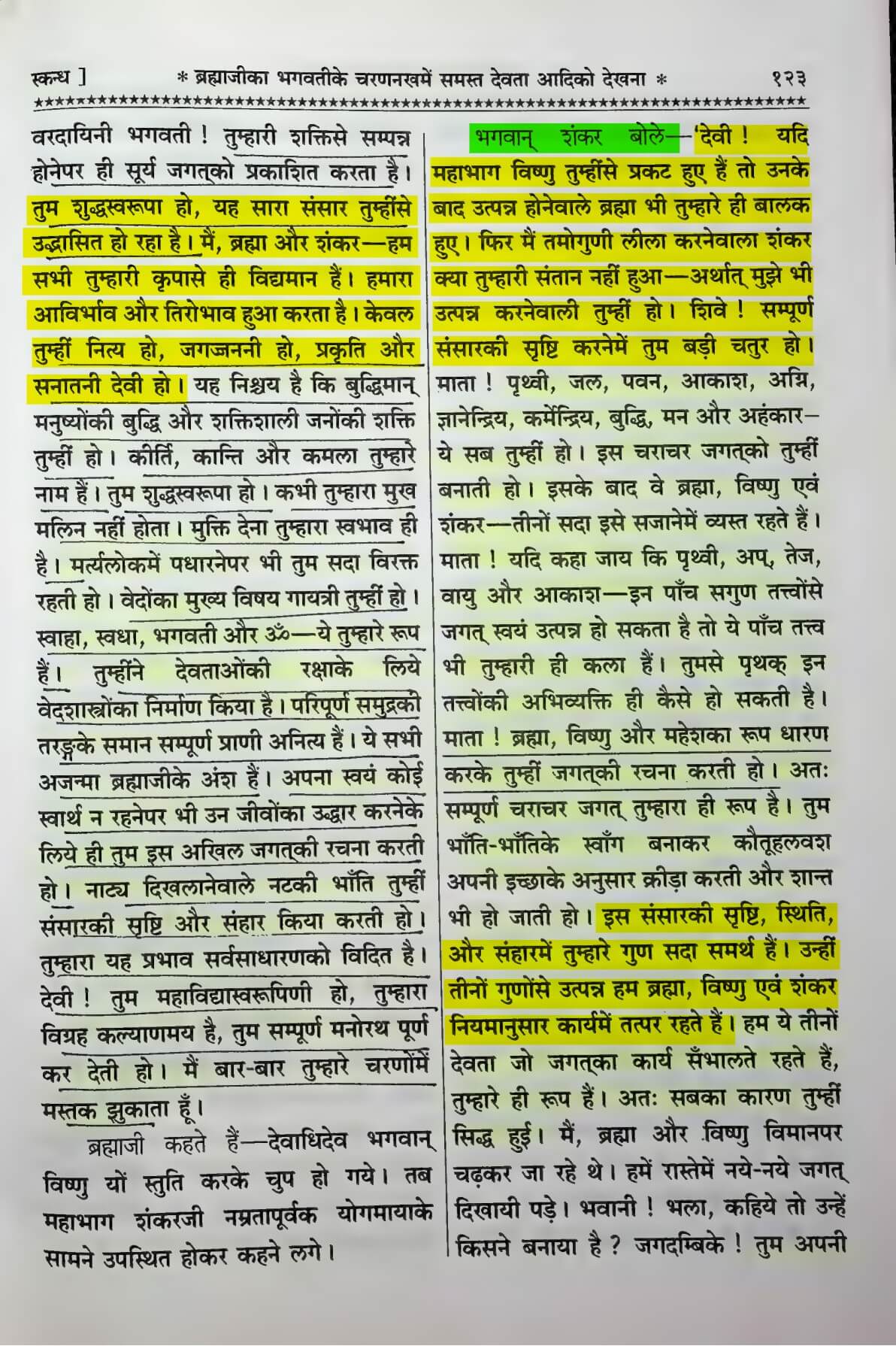
The most direct admission from the destruction aspect of the Trinity occurs in shrimad-devi-bhagwat-page123-full.jpg. Lord Shiva addresses the Goddess directly with deep humility, explicitly linking his birth and the birth of his brothers to her womb:
"Goddess! If the highly fortunate Vishnu has manifested from you, then Brahma, who was born after him, is also your child. Then, am I—Shiva, who performs the Tamoguni play—not your son? Meaning, I am also created by you."
Shiva further emphasizes that the three deities are entirely bound by her gunas (Sattva, Rajas, Tamas) and are perpetually appointed to execute her cosmic administration according to her rules.
Part 3: Cross-Scriptural Core Lineage Matrix
When aligning the independent records of both the Shiva Purana and Devi Bhagwat Purana, the family tree of the universe becomes perfectly clear:
| Deity | Relationship Status | Scriptural Title / Names | Direct Proof Source |
|---|---|---|---|
| Lord Sadashiva |
(Kaal-Brahm) | The Cosmic Father | Isvara, Paramapurusha, Maheshvara, Nirgun-Sakar Brahm | Manifested before the worlds; cast Brahma and Vishnu from his own physical limbs. | | Goddess Durga
(Ashta-Bhujaen) | The Cosmic Mother | Parashakti, Ambika, Purna Prakriti, Jagadamba, Tridevjanani | Explicitly acknowledged as the mother by infant Vishnu, Brahma, and through direct prayers by Shiva. | | Brahma, Vishnu, Shiva | The Progeny | The Trimurti / Tridev | Created via the union and instruction of Sadashiva and Prakriti to handle universal affairs. |
Conclusion: The Final Verdict
The common narrative that the Trimurti have no origin is explicitly cleared up within internal Puranic text architecture. The Shiva Purana tracks the structural emergence of the deities from the right and left sides of the Father, while the Devi Bhagwat Purana records the personal, humble admissions of Brahma, Vishnu, and Shiva stating that they are the sons of the supreme Goddess.
Therefore, according to scriptural proof, the true cosmic Father of Brahma, Vishnu, and Shiva is Lord Sadashiva, and their true cosmic Mother is Goddess Durga.
Evidence
Shiv Purana
Devi Bhagwat Purana
पुराणों का सरल हिंदी रूपांतरण (Summary in Hindi)
शिव पुराण और श्रीमद्देवीभागवत पुराण के इन दुर्लभ पन्नों में छिपे त्रिदेवों के माता-पिता का रहस्य इस प्रकार है:
१. पिता का प्राकट्य (शिव पुराण - रुद्रसंहिता)
- सृष्टि से पूर्व की स्थिति: सृष्टि रचना से पहले केवल महाशून्य और घोर अंधकार था, जिसमें केवल 'सत्-ब्रह्म' (निराकार परमेश्वर) विद्यमान थे।
- सदाशिव का प्रकट होना: उस निराकार ब्रह्म ने अपनी लीला के लिए एक साकार पुरुष का रूप धारण किया, जिन्हें 'भगवान सदाशिव' (काल-ब्रह्म) कहा जाता है। इनके ५ मुख और १० भुजाएं हैं। ये ही ब्रह्मांड के आदि पिता हैं।
२. माता दुर्गा की उत्पत्ति (शिव पुराण - रुद्रसंहिता)
- त्रिदेव जननी: भगवान सदाशिव ने अपने ही शरीर से एक परमेश्वरी शक्ति को प्रकट किया, जिन्हें पराशक्ति, प्रधान प्रकृति, जगदम्बा और अम्बिका (दुर्गा) कहा गया है।
- स्वरूप: पुराण स्पष्ट कहता है कि सदाशिव द्वारा प्रकट की गई इस देवी की ८ भुजाएं हैं। इन्हें ही तीनों देवों (ब्रह्मा, विष्णु, महेश) की माता (त्रिदेवजननी) घोषित किया गया है।
३. त्रिदेवों का जन्म (शिव पुराण एवं देवीभागवत)
- विष्णु जी का जन्म: भगवान सदाशिव ने अपने वाम भाग (बाएं हिस्से) से भगवान विष्णु को प्रकट किया। देवीभागवत पुराण में स्वयं विष्णु जी स्वीकार करते हैं कि प्रलय के समय जल में बालक रूप में उन्हें पालने में झुलाने वाली ये आदि-शक्ति दुर्गा ही हैं, जो हम सबकी जननी हैं।
- ब्रह्मा जी का जन्म: शिव पुराण में स्वयं ब्रह्मा जी कहते हैं कि कल्याणकारी सदाशिव ने उन्हें अपने दाहिने अंग से उत्पन्न किया।
- शिव जी की गवाही: श्रीमद्देवीभागवत पुराण में स्वयं भगवान शंकर (महादेव) देवी को संबोधित करते हुए कहते हैं—"हे देवी! यदि विष्णु और ब्रह्मा आपकी संतान हैं, तो क्या तमोगुण लीला करने वाला मैं (शंकर) आपका पुत्र नहीं हुआ? अर्थात मुझे भी उत्पन्न करने वाली आप ही हैं।"
Frequently Asked Questions (FAQs)
Q1: Who are the ultimate cosmic Father and Mother of Brahma, Vishnu, and Shiva?
- Answer: According to the combined evidence of the Shiva Purana and the Shrimad Devi Bhagwat Purana, the Hindu Trinity (Trimurti) is not without lineage. Their ultimate cosmic Father is Lord Sadashiva (the manifest form of the unmanifest Supreme Absolute, also understood as Kaal-Brahm), and their ultimate cosmic Mother is Goddess Durga (addressed in the texts as Parashakti, Purna Prakriti, Ambika, or Jagadambika).
Q2: Is Lord Sadashiva different from the Lord Shiva (Shankar) belonging to the Trinity?
- Answer: Yes, they are completely distinct entities in cosmic hierarchy. The Shiva Purana clarifies that Lord Sadashiva is the primordial father who exists prior to creation. Lord Shiva (Shankar), the deity assigned to the task of cosmic dissolution, is a subsequent manifestation and is explicitly identified as the son of Sadashiva and Durga.
Q3: Where is the direct proof in the scriptures that the Trinity are the children of Goddess Durga?
- Answer: Direct proof is found in the Shrimad Devi Bhagwat Purana. In Skandha 3, Lord Vishnu openly remembers the Goddess rocking his cradle during the cosmic dissolution and proclaims her as the "mother of us all". Furthermore, Lord Shiva directly addresses the Goddess, stating that if Vishnu and Brahma are born from her, then he (Shiva) is inevitably her son as well.
Q4: How does the Shiva Purana describe the physical birth or manifestation of the Trinity?
- Answer: In Chapter 6 of the Rudra Samhita, it is revealed that Lord Sadashiva manifested Lord Vishnu from his left side (specifically his tenth limb) and breathed the knowledge of the Vedas into him. Following this, Lord Brahma narrates that Sadashiva exerted his divine will to create Lord Brahma directly from his right limb.
Q5: Why do mainstream traditions often state that Brahma, Vishnu, and Shiva have no parents?
- Answer: Mainstream traditions frequently look at localized, earthly pastimes (Leelas) where the deities appear to manifest spontaneously (such as Brahma appearing on a lotus). However, when tracking the macro-cosmic lineage back to the very beginning of the universe (Mahapralaya), the core Puranas explicitly trace their origin back to the union of the primordial Purusha (Sadashiva) and Prakriti (Durga).
◄ Are Brahma, Vishnu, and Shiva Mortal? The Ultimate Guide to the Husband of Goddess Durga ➤
