Shiva vs. Sadashiva
Find Answers / Shiva vs. Sadashiva
Shiva vs. Sadashiva
Shiva vs. Sadashiva: Clearing the Ultimate Puranic Identity Confusion
For the vast majority of spiritual seekers and casual readers, the names "Shiva," "Shankar," "Mahadeva," and "Sadashiva" refer to the exact same deity. We naturally picture the ascetic yogi with matted hair, a crescent moon, and a trident, meditating on Mount Kailash.
However, if you transcend popular folklore and deeply analyze the internal text architecture of the Shiva Purana (Rudra Samhita) and the Shrimad Devi Bhagwat Purana, this assumption collapses. The scriptures reveal a profound, jaw-dropping cosmic reality: The Lord Shiva (Shankar) who belongs to the Trinity is the cyclic son, while Lord Sadashiva is his primordial, eternal cosmic Father.
By looking strictly at the scriptural pages, we can permanently separate the Father from the Son.
Part 1: Who is Lord Sadashiva? (The Cosmic Father)
To understand the lineage, we must first look at the state of existence before the creation of our material universe.
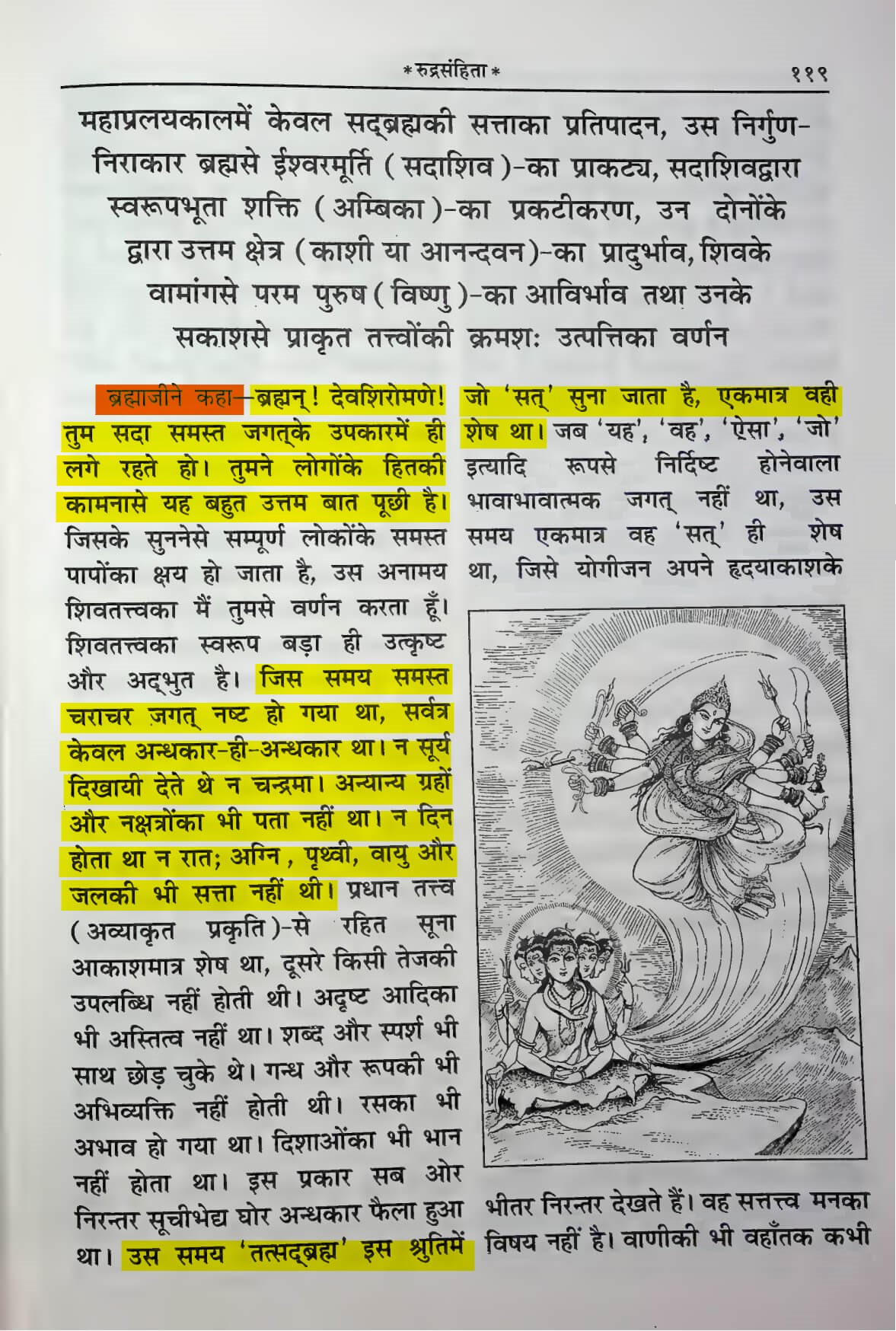
1. The Pre-Creation State
According to shiv-purana-rudrasamhita-page119.jpg, before anything was made, there was only a dense, pitch-black void. No elements, stars, or planets existed. There was only a formless, qualityless absolute reality referred to in the Vedas as Tat Sadbrahm.
2. The Manifestation of the Supreme Father
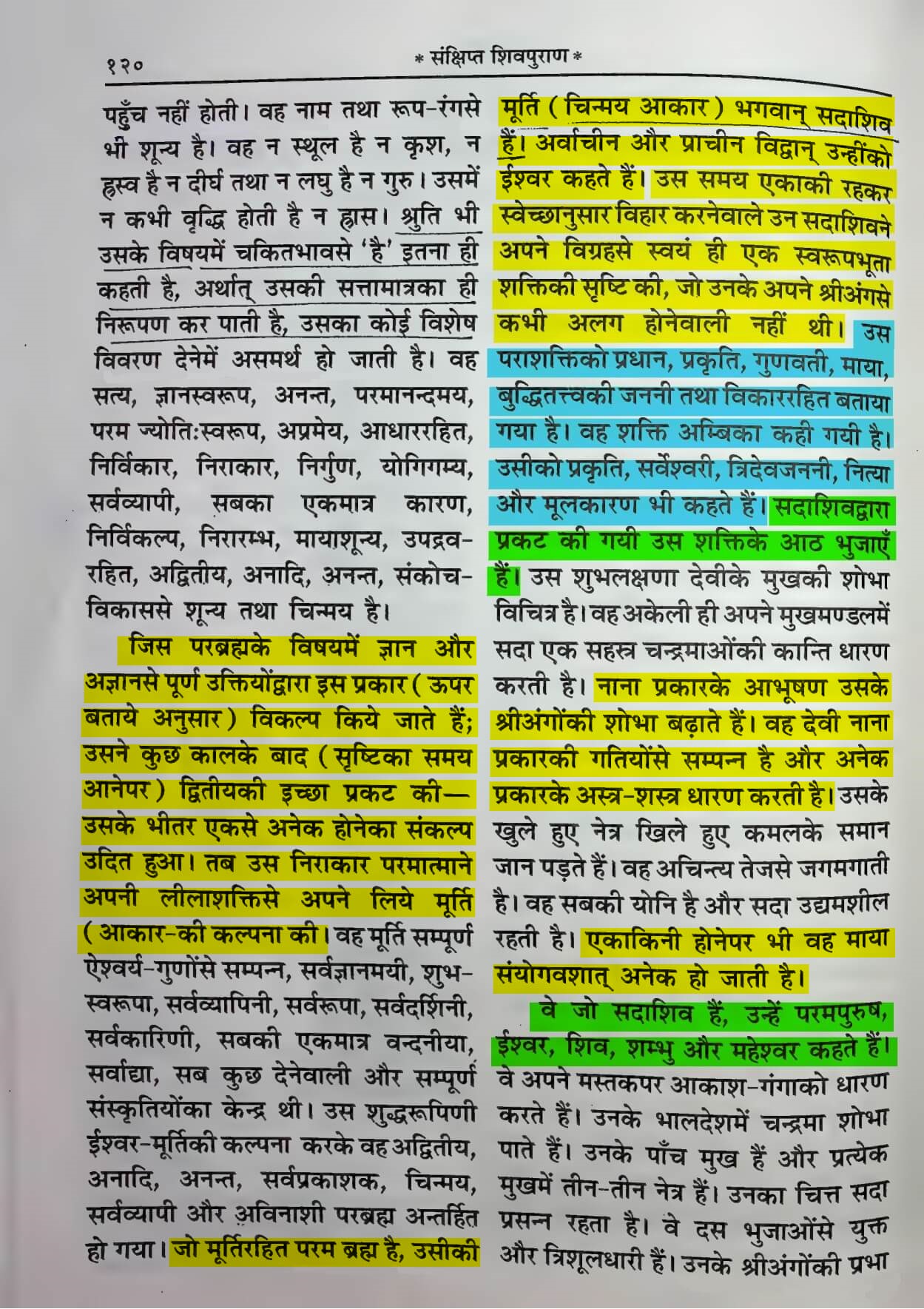
As documented in shiv-purana-rudrasamhita-page120.jpg, to engage in divine cosmic play, that formless reality manifested an all-pervading, conscious physical form. This supreme entity is Lord Sadashiva (also known as Kaal-Brahm).
- His Iconography: The scriptures describe Lord Sadashiva as a grand, cosmic deity possessing five faces, ten arms, and three eyes per face.
- His Status: He resides in the eternal, absolute realm of Shivaloka (Kashi), which sits safely above the material universe. He is the ultimate Purusha (cosmic male) who manifests Goddess Durga from his own body to act as his eternal wife.
Part 2: Who is Lord Shiva/Shankar? (The Administrative Son)
Once Lord Sadashiva and Goddess Durga established their celestial home, they brought forth three sons to manage the material worlds: Brahma, Vishnu, and a third son whom they named Shiva (or Shankar).
1. The Direct Admission of Sonship
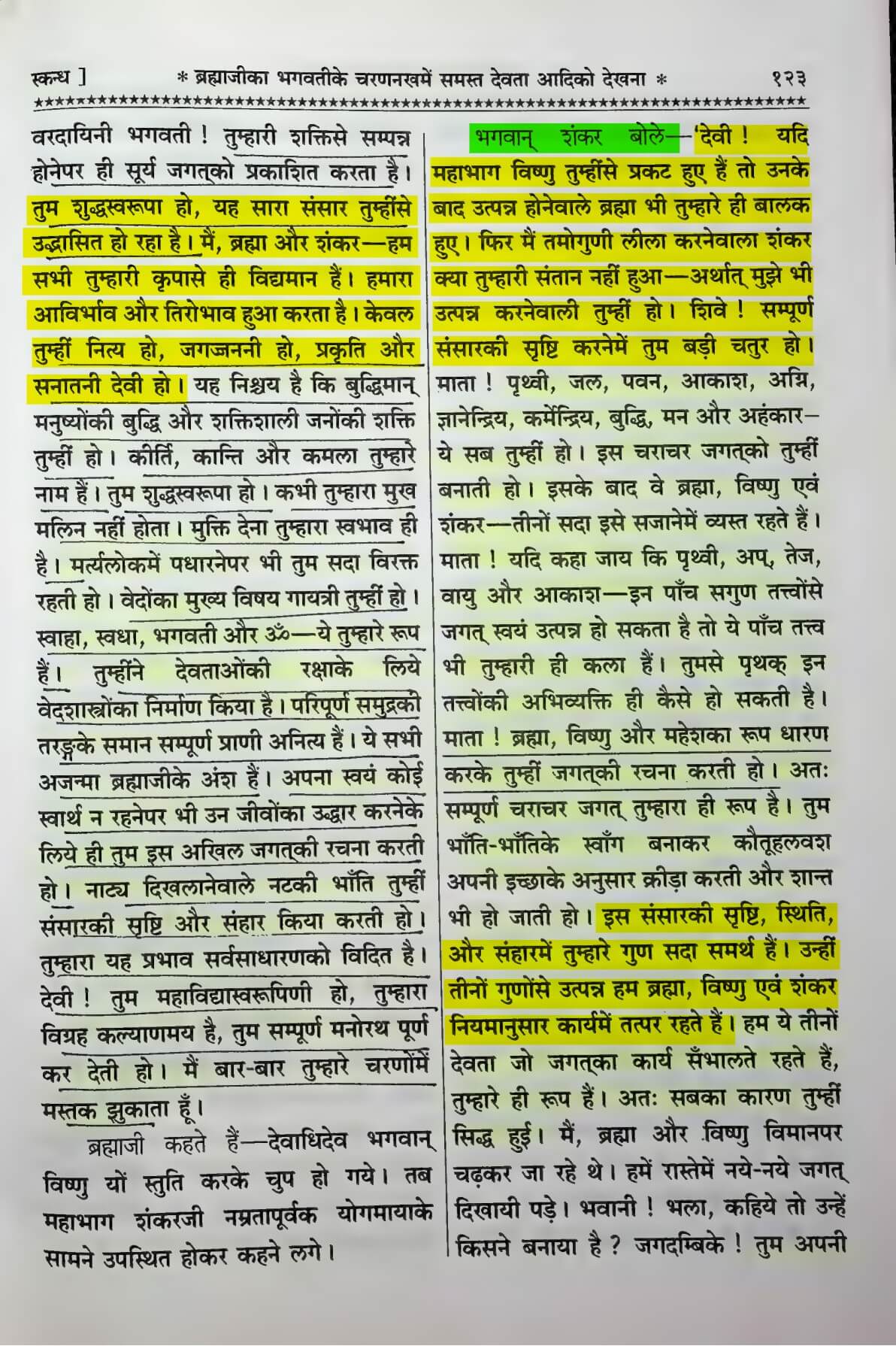
The absolute proof that the Trinity's Shiva is a son—and not the self-existent father—is found on shrimad-devi-bhagwat-page123-full.jpg. Lord Shiva directly offers a humble prayer to his mother, Goddess Durga, stating:
"Goddess! If the highly fortunate Vishnu has manifested from you, then Brahma, who was born after him, is also your child. Then, am I—Shiva, who performs the Tamoguni play—not your son? Meaning, I am also created by you."
2. The Assignment of the "Tamoguni" Role
On that same page (shrimad-devi-bhagwat-page123-full.jpg), Lord Shiva explicitly defines his structural role in the universe as a Tamoguni play. While his brother Brahma is assigned Rajoguna (creation) and Vishnu is assigned Satvoguna (preservation), Shiva is tasked with Tamoguna (the ultimate destruction of the material universe when its time expires).
3. His Iconography and Abode
Unlike his five-faced, ten-armed cosmic father who lives outside the material realm, the son (Lord Shankar) manifests with one face, two or four arms, and is assigned to live on Mount Kailash within the material universe to execute his localized duties.
Part 3: The Mortality Difference ("Aavirbhaav" and "Tirobhaav")
The definitive line of separation between the Father (Sadashiva) and the Son (Shiva) lies in their relationship with cosmic time.
As documented on shrimad-devi-bhagwat-page123-full.jpg, Lord Shiva confesses that he and his brothers are bound by cyclic time:
"Hamara aavirbhaav aur tirobhaav hua karta hai. Keval tumhi nitya ho..." (Our manifestation/birth and withdrawal/death keep happening. Only you are eternal...)
- The Son (Shiva/Shankar): Experiences Aavirbhaav (creation) and Tirobhaav (dissolution). When the macro-cosmic timeline finishes, the physical form of Lord Shankar dissolves completely back into his original parents.
- The Father (Lord Sadashiva): Is completely Nitya (eternal) alongside Goddess Durga. He never undergoes dissolution; instead, he is the one who absorbs the Trinity back into his own body during Mahapralaya.
⚡ Comparative Identity Matrix
| Cosmic Attribute | Lord Sadashiva (The Father) | Lord Shiva / Shankar (The Son) |
|---|---|---|
| Cosmic Hierarchy | The Supreme Primordial Parent (Kaal-Brahm). | The Third Deity of the Trinity (Trimurti). |
| Physical Form | Five faces and ten arms. | One face and two/four arms (The Yogi). |
| Abode | Shivaloka / Kashi (Above the material world). | Mount Kailash (Within the material world). |
| Lineage Status | Has no mother or father; manifests from the absolute void. | Born from the union of Sadashiva and Goddess Durga. |
| Relationship to Death | Beyond Dissolution. Completely eternal. | Subject to Tirobhaav. Merges back into his parents at the end of the cosmic cycle. |
| Scriptural Scans | shiv-purana-rudrasamhita-page120.jpg |
shrimad-devi-bhagwat-page123-full.jpg |
Conclusion: Why the Confusion Exists
The deep confusion among modern believers happens because Lord Sadashiva (the Father) named his third son "Shiva" after his own primary attribute of ultimate auspiciousness. Because the son carries the divine name, authority, and traits of his Father, casual readers naturally assume they are looking at the same entity.
But by aligning the Shiva Purana with the Devi Bhagwat Purana, the family tree is perfectly sorted. Lord Sadashiva is the eternal cosmic Father, and Lord Shiva (Shankar) is his highly powerful, administrative son who manages the cycle of destruction.
Evidence - Shiv Purana
Evidence - Shrimad Devi Bhagwat Purana
पुराणों का सरल हिंदी रूपांतरण: शिव और सदाशिव में क्या अंतर है?
शिव पुराण और श्रीमद्देवीभागवत पुराण के स्पष्ट प्रमाणों के अनुसार, भगवान सदाशिव (पिता) और भगवान शिव/शंकर (पुत्र) के बीच का अंतर इस प्रकार है:
१. भगवान सदाशिव: ब्रह्मांड के आदि पिता
- सृष्टि से पूर्व का प्राकट्य: जब ब्रह्मांड में केवल महाशून्य था, तब निराकार ब्रह्म ने अपनी इच्छा से एक साकार रूप धारण किया, जिन्हें 'भगवान सदाशिव' (काल-ब्रह्म) कहा जाता है.
- दिव्य स्वरूप और स्थान: शिव पुराण के अनुसार, सदाशिव के ५ मुख और १० भुजाएं हैं। ये भौतिक ब्रह्मांड से ऊपर 'शिवलोक' (परम काशी) में निवास करते हैं।
- वंश स्थिति: ये अजन्मे हैं (इनके कोई माता-पिता नहीं हैं)। ये और माता दुर्गा (पराशक्ति) ही इस संपूर्ण सृष्टि के आदि जनक और जननी हैं.
२. भगवान शिव (शंकर): सदाशिव और दुर्गा के पुत्र
- पुत्र होने का अकाट्य प्रमाण:
shrimad-devi-bhagwat-page123-full.jpgपर भगवान शंकर स्वयं माता दुर्गा के सामने हाथ जोड़कर कहते हैं:"हे देवी! यदि महाभाग विष्णु और उनके बाद उत्पन्न होने वाले ब्रह्मा आपकी संतान हैं... तो क्या तमोगुण लीला करने वाला मैं (शंकर) आपकी संतान नहीं हुआ? अर्थात मुझे भी उत्पन्न करने वाली आप ही हैं।"
- स्वरूप और कार्य: सदाशिव के तीसरे पुत्र (शंकर) का १ मुख और २ या ४ भुजाएं हैं। इन्हें भौतिक ब्रह्मांड के भीतर 'कैलाश पर्वत' पर रहने और सृष्टि के संहार (तमोगुण लीला) का कार्य सौंपा गया है.
३. अमरता और काल का अंतर (आविर्भाव-तिरोभाव)
- भगवान शिव (पुत्र):
shrimad-devi-bhagwat-page123-full.jpgपर तीनों देव स्पष्ट स्वीकार करते हैं कि उनका आविर्भाव (प्रकट होना/जन्म) और तिरोभाव (विलीन होना/मृत्यु) होता रहता है. महाप्रलय के समय भगवान शंकर का यह स्वरूप पूरी तरह समाप्त होकर अपने मूल माता-पिता में समाहित हो जाता है। - भगवान सदाशिव (पिता): ये और दुर्गा जी पूरी तरह से 'नित्य' (शाश्वत/Eternal) हैं, जो महाप्रलय में भी कभी नष्ट नहीं होते.
⚡ शिव बनाम सदाशिव: तुलनात्मक तालिका (Comparison Matrix)
| दिव्य लक्षण / गुण | भगवान सदाशिव (पिता) | भगवान शिव / शंकर (पुत्र) |
|---|---|---|
| ब्रह्मांडीय पद | सर्वोच्च आदि पुरुष (काल-ब्रह्म)। | त्रिदेवों (Trimurti) के तीसरे देवता। |
| शारीरिक स्वरूप | ५ मुख और १० भुजाएं। | १ मुख और २ या ४ भुजाएं (योगी रूप)। |
| स्थायी निवास | शिवलोक / परम काशी (माया से परे)। | कैलाश पर्वत (भौतिक ब्रह्मांड के भीतर)। |
| जन्म का इतिहास | स्वयं प्रकट (इनके कोई माता-पिता नहीं हैं)। | सदाशिव और माता दुर्गा के संयोग से जन्म. |
| काल की सीमा | अविनाशी (Nitya): प्रलय से परे हैं. | तिरोभाव के अधीन: प्रलय में विलीन होते हैं. |
| प्रामाणिक पेज | shiv-purana-rudrasamhita-page120.jpg |
shrimad-devi-bhagwat-page123-full.jpg |
निष्कर्ष: आम जनता में भ्रम इसलिए है क्योंकि पिता (सदाशिव) ने अपने गुण के आधार पर अपने तीसरे पुत्र का नाम भी "शिव" रखा। लेकिन पुराणों के गहन अध्ययन से यह साफ है कि भगवान सदाशिव अजन्मे पिता हैं, और भगवान शंकर उनके आज्ञाकारी पुत्र हैं जिन्हें सृष्टि के संहार का कार्य मिला है।
Frequently Asked Questions (FAQs)
Q1: Are Lord Shiva and Lord Sadashiva the same entity?
- Answer: No. According to the structural hierarchy laid out in the Shiva Purana, Lord Sadashiva is the primordial Cosmic Father who exists prior to creation, while Lord Shiva (Shankar) is his biological son, brought forth alongside Brahma and Vishnu to manage a specific function within the material universe.
Q2: What is the physical difference in appearance between Sadashiva and Shiva (Shankar)?
- Answer: The Shiva Purana explicitly details their distinct iconography. Lord Sadashiva manifests with a massive cosmic form featuring five faces and ten arms. In contrast, his son, Lord Shiva (Shankar), manifests with one face and two or four arms, appearing in the traditional attire of a meditating yogi.
Q3: Where do Lord Sadashiva and Lord Shiva live?
- Answer: They reside in completely different realms. Lord Sadashiva lives in Shivaloka (Param Kashi), an eternal spiritual domain that exists far above the material universes and survives cosmic collapse. Lord Shiva (Shankar) resides on Mount Kailash, which is located within the physical material universe where he can oversee his cosmic duties.
Q4: If Lord Shiva (Shankar) is a son, why did his Father name him Shiva?
- Answer: In the Shiva Purana, it is explained that the Cosmic Father (Sadashiva) named his third son "Shiva" or "Shankar" after his own divine quality of ultimate auspiciousness. Because the son carries the Father’s name, characteristics, and immense power, casual readers across generations mistakenly assumed they were the exact same person.
Q5: Who undergoes "Aavirbhaav" and "Tirobhaav" between the two?
- Answer: On page 123-full of the Shrimad Devi Bhagwat Purana, Lord Shiva (Shankar) explicitly states that he, Brahma, and Vishnu undergo Aavirbhaav (birth) and Tirobhaav (dissolution). Lord Sadashiva, however, is Nitya (completely eternal) and does not undergo these cycles; he is the one who reabsorbs the Trinity at the end of the universe.
◄ The Ultimate Guide to the Husband of Goddess Durga Brahm and Durga - Two Different Entities ➤
