The Cosmic Hierarchy: Why Sadashiva Stopped Brahma & Vishnu's War
Find Answers / The Cosmic Hierarchy: Why Sadashiva Stopped Brahma & Vishnu's War
The Cosmic Hierarchy: Why Sadashiva Stopped Brahma & Vishnu's War
The Cosmic Hierarchy: When Sadashiva Interrupted the War of Brahma and Vishnu
In popular understanding, the Hindu Trinity exists as a horizontal tier of absolute equals: Brahma creates, Vishnu preserves, and Shiva destroys. They are traditionally viewed as the ultimate, self-begotten authors of existence.
However, when we delve into the core of the Shiva Purana (Vidyesvara Samhita), this horizontal power structure is completely overturned. Through a series of critical revelations spanning Chapters 5, 9, and 10, the text exposes a rigorous cosmic hierarchy. It reveals that the Brahma and Vishnu we know are not independent operators, but subordinate deities answering to a higher, five-faced supreme progenitor: Lord Sadashiva.
By reading through the text of Shiv Puran Vidhweswar Samhita page-11 through adhyay 10 page-19, we can trace how a petty ego war between creation and preservation forced the supreme source to step in, treat them like children, and explain the five-fold division of the cosmos.
Part 1: The Outbreak of the Ego War
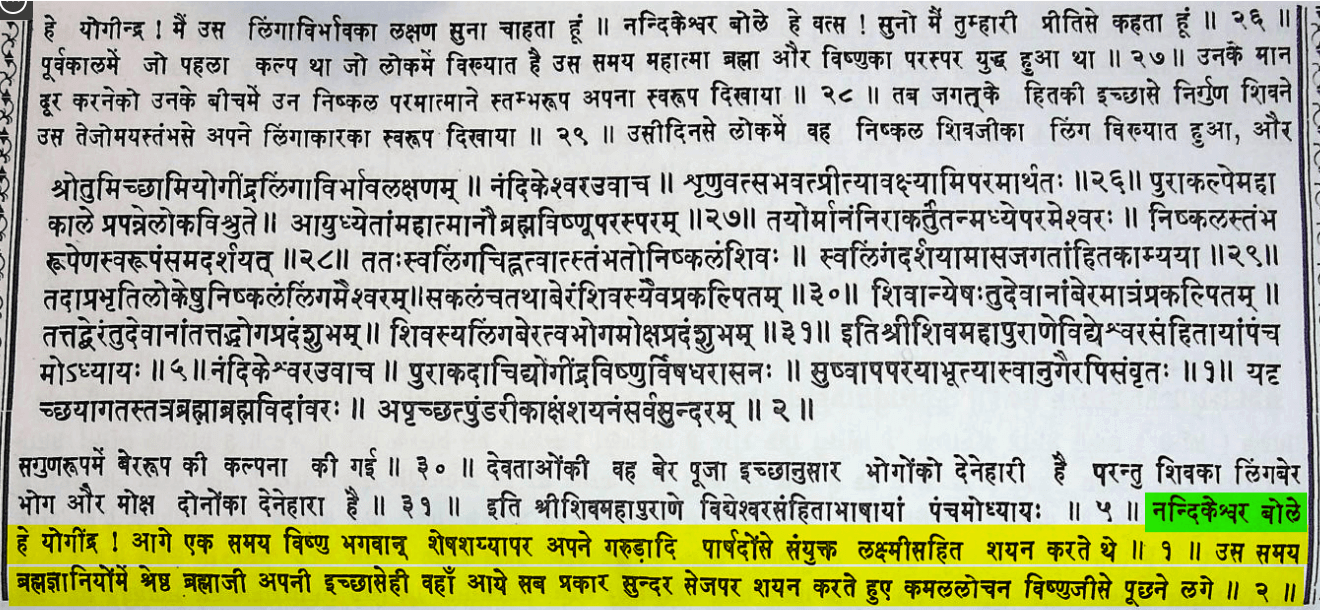
The crisis begins on Shiv Puran Vidhweswar Samhita-page 11 and page-11 (part 2). Lord Vishnu is resting peacefully upon his serpent bed when Brahma arrives. Blinded by localized ego, Brahma looks down at Vishnu and demands to know why Vishnu is sleeping like a subordinate instead of rising to greet his master:
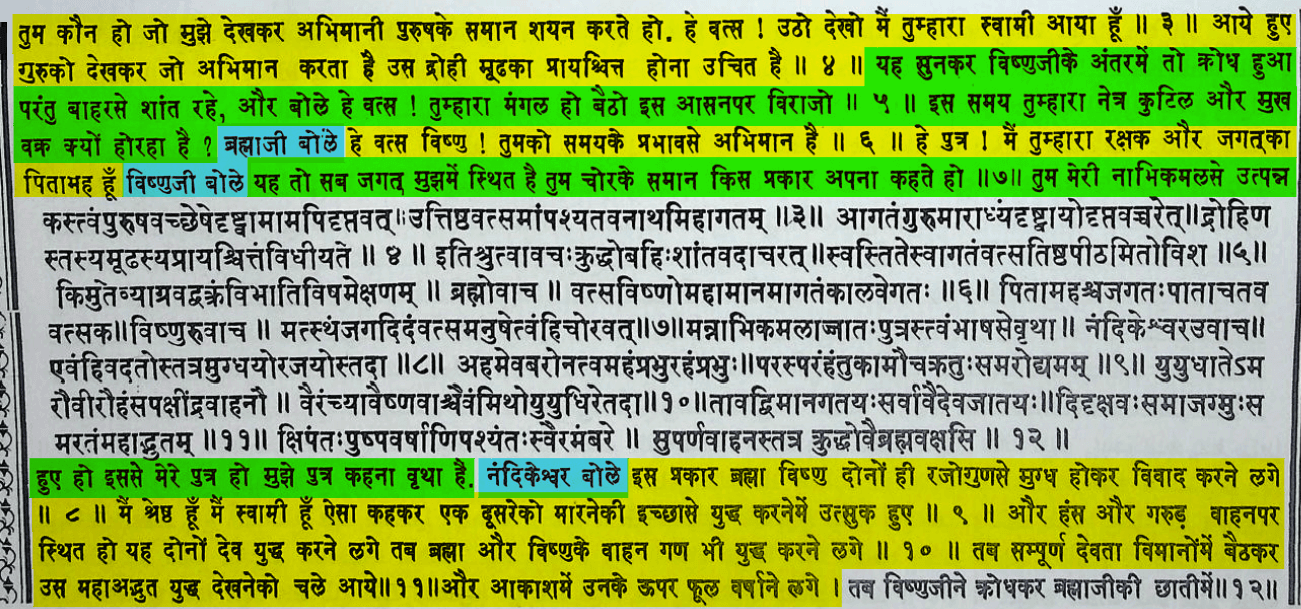
"Who are you that sleeps before me like an arrogant man? Rise, child! Look, I am your Master (Swami) who has arrived. It is fitting that a treacherous fool who shows pride before his Guru performs penance!" (
page 11 part2)
Vishnu, naturally infuriated but maintaining an outwardly calm demeanor, fires back, pointing out that Brahma actually emerged from a lotus rooted in Vishnu’s own navel:
"You speak like a thief! The entire universe rests inside me, and you were born from the lotus arising from my navel. How dare you call yourself my master?" (
page 11 part2)
The argument quickly degenerates. Driven by the blinding influence of Rajoguna (passion), the two deities mount their respective vehicles—the Swan and the Garuda—and launch into a devastating war. The text notes that the entire assembly of demigods watches in sheer horror as the two forces collide, threatening to tear the fabric of reality apart.
Part 2: The Manifestation of the Infinite Pillar
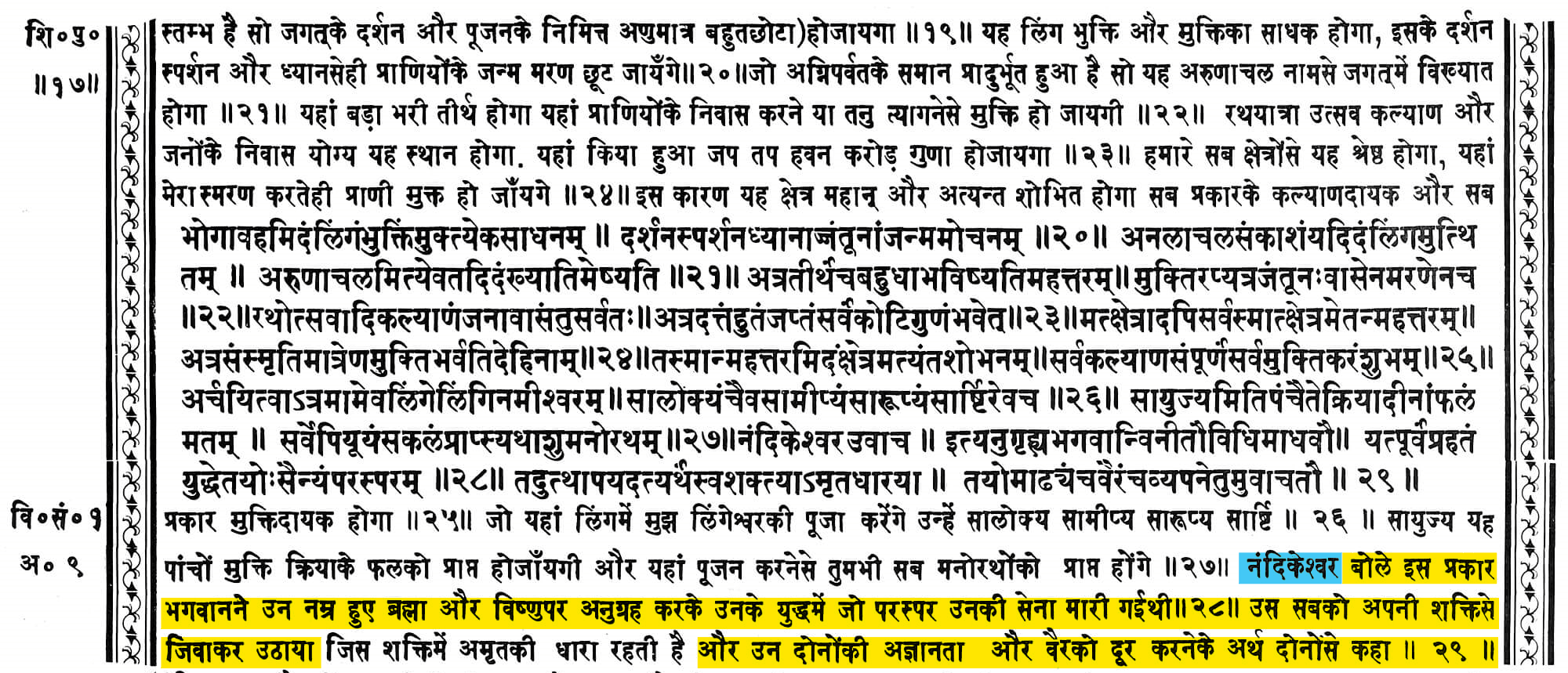
To avert a total cosmic collapse, Lord Sadashiva intervenes. As detailed on Shiv Puran Vidhweswar Samhita Adhyay 9 page 17, he manifests between the two warring armies as an incomprehensible, boundless Pillar of Fire (Tejomay Stambha).
Stunned by this sudden anomaly, Brahma and Vishnu temporarily call a truce to locate the column's boundaries—Brahma flies upward for thousands of years as a swan, and Vishnu digs downward as a boar. Both fail completely. Recognizing their utter limitations, their toxic pride dissolves into absolute humility.
On page 17 (part2), Nandikesvara narrates that Lord Sadashiva, deeply pleased by their surrendered posture, uses his immense power to resurrect the fallen armies with a shower of nectar and steps out from the pillar to address them.
Part 3: "Rise, Children!" — The Hierarchy Exposed
The core theological revelation hits its absolute peak on Shiv Puran Vidhweswar Samhita-adhyay 10 page 18. Stepping out from the pillar, Sadashiva looks down at the two trembling deities and addresses them with a word that instantly resets their existential status: "Children" (Putro).
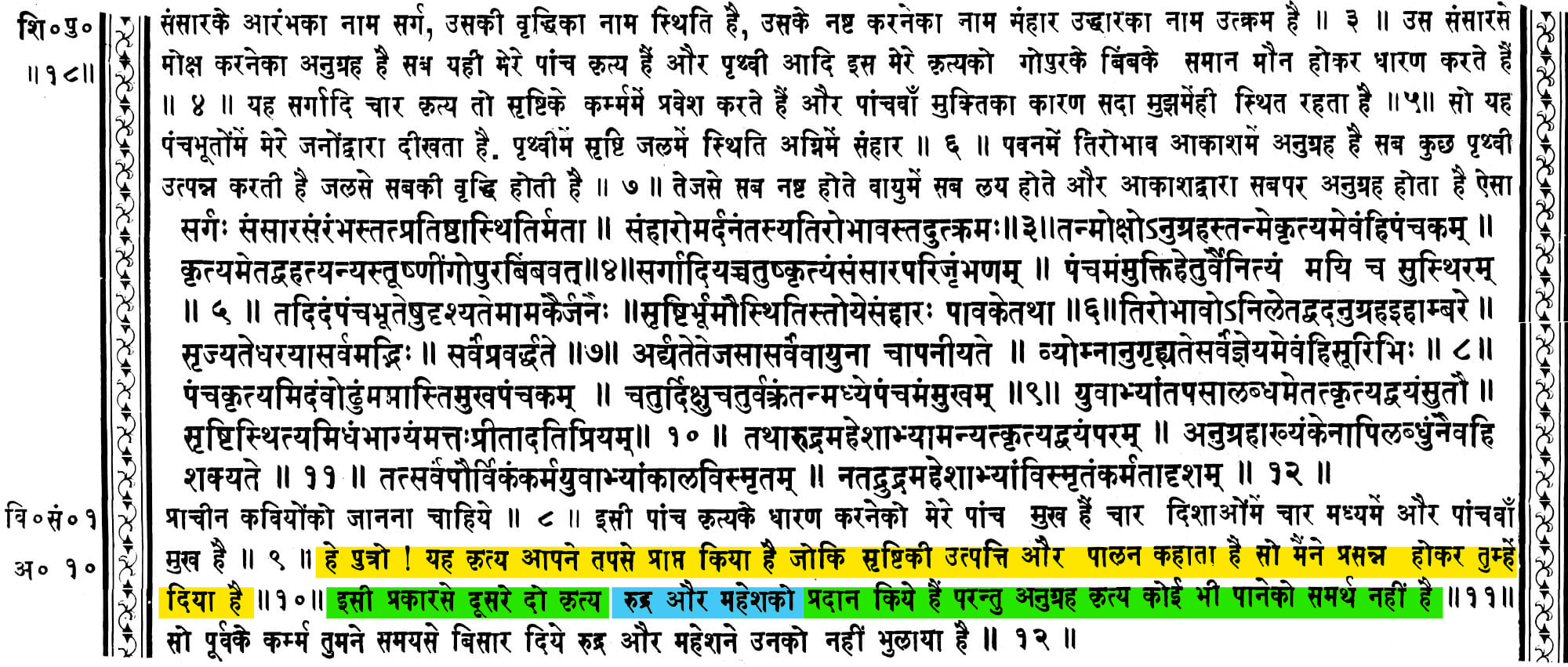
"हे पुत्रो ! यह कृत्य आपने अपने तपसे प्राप्त किया है जो कि सृष्टिकी उत्पत्ति और पालन कहाता है सो मैंने प्रसन्न होकर तुम्हें दिया है॥ १०॥" ("O Children! You have obtained these duties through your penance—which are known as the Creation and Preservation of the cosmos. I, being highly pleased, have gifted these portfolios to you.") (
adhyay-10 page-18)
               [ LORD SADASHIVA ]
          (The Sovereign 5-Faced Source)
                        │
       ┌──────────┬─────┴─────┬──────────┐
       ▼          ▼           ▼          ▼
   [Brahma]    [Vishnu]    [Rudra]   [Maheshwar]
   Creation  Preservation Destruction Concealment
Sadashiva explicitly dismantles their claim to ultimate lordship by laying out the Five Cosmic Duties (Pancha-Kritya) and revealing exactly how the administrative portfolios are distributed:
- Sarga (Creation): Delegated directly to Brahma.
- Sthiti (Preservation): Delegated directly to Vishnu.
- Samhar (Destruction): Delegated to Rudra.
- Tirobhav (Causing death): Delegated to Maheshwar.
- Anugraha (Grace/Liberation): Retained permanently and exclusively by Sadashiva himself.
Sadashiva adds a sharp, corrective rebuke: “You two forgot your true positions due to a lapse in memory and time. But Rudra and Maheshwar have never forgotten the duties I allocated to them.” (adhyay-10 page-18)
Part 4: Maheshwar vs. Sadashiva (The Form Context)
In Puranic cosmology, Sadashiva is the unmanifest, formless supreme source (Nishkala), whereas Maheshwar is his son tasked of causing destruction and death.
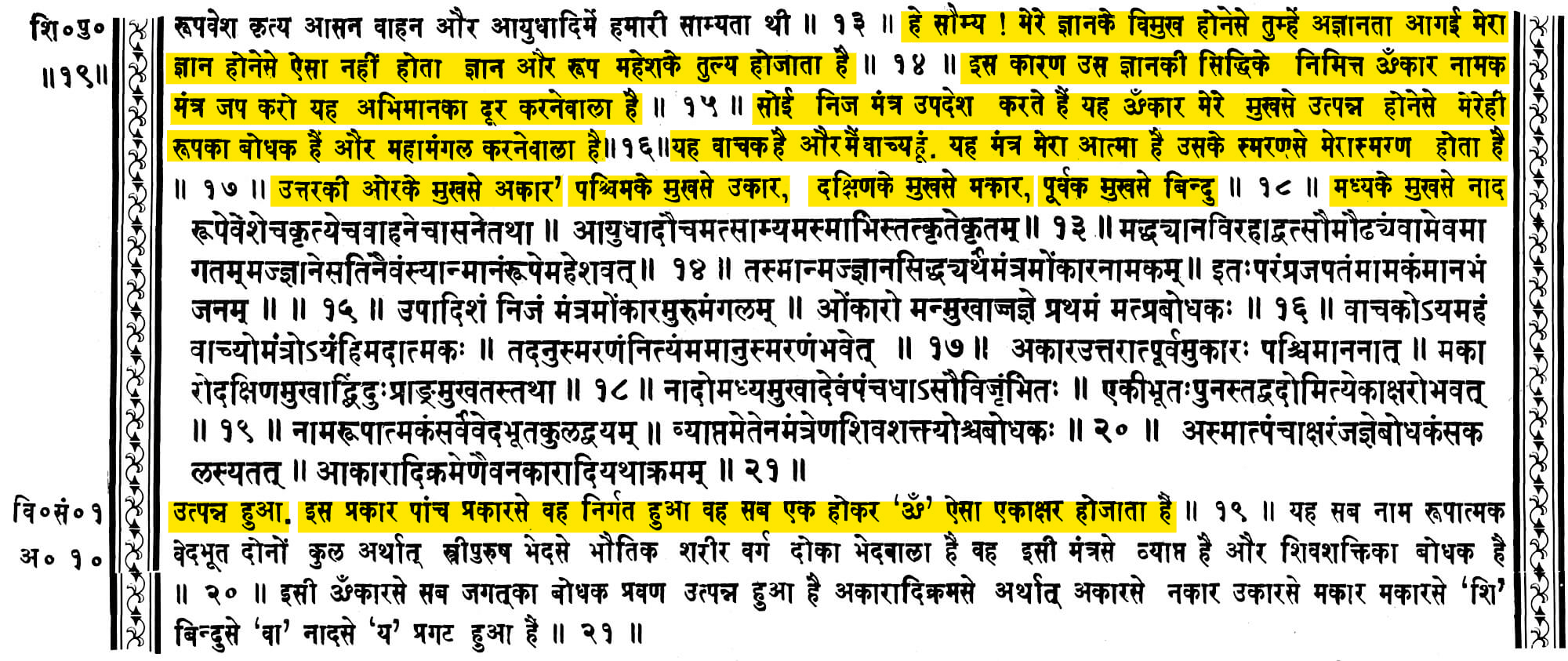
On page-19, Sadashiva explains that because Brahma and Vishnu lost their spiritual alignment, they sank into ignorance. To remedy this, he initiates them into the primordial syllable OM (AUM), explaining that true spiritual wisdom elevates a soul to the status of Maheshwar:
"मेरा ज्ञान होनेसे ऐसा नहीं होता ज्ञान और रूप महेशके तुल्य होजाता है॥ १४॥" ("When you attain my ultimate knowledge, your ignorance dissolves, and your wisdom and form become equal to that of Maheshwar.") (
adhyay-10 page-19)
He goes on to show how the very letters of the Pranava Mantra (Omkar) manifest directly from his five cosmic faces: the letter 'A' from his northern face, 'U' from his western face, 'M' from his southern face, the cosmic Bindu from his eastern face, and the primordial Nada from his central face (adhyay-10 page-19). From this sacred acoustic blueprint, the entire physical universe—and the powers of the Trinity—are generated.
The Ultimate Lesson of the Column of Fire
On page-17, Sadashiva leaves Brahma and Vishnu with a profound philosophical truth regarding his dual nature:
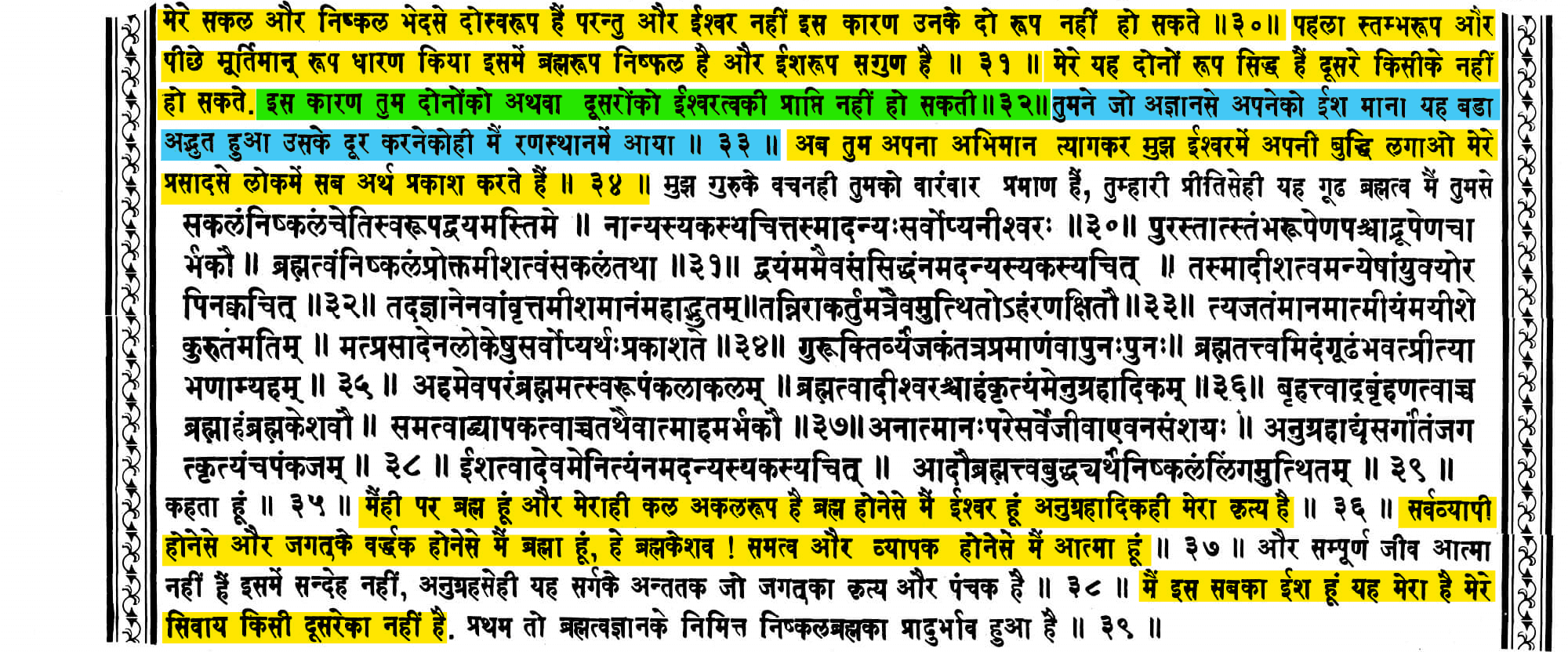
"मेरे सकल और निष्कल भेदसे दो स्वरूप हैं... पहला स्तम्भरूप और पीछे मूर्तिमान् रूप धारण किया इसमें ब्रह्मरूप निष्कल है और ईशरूप सगुण है॥ ३१॥" ("I possess two distinct aspects: the Manifested (Sakala) and the Unmanifested (Nishkala)... The pillar form you witnessed is my attribute-less, absolute reality (Nishkala-Brahman), while my embodied personal form is the qualified Lord (Saguna-Isha).") (
adhyay-9-page-17part2.jpg)
He looks at them gently and delivers the final humbling blow: “Because you both falsely imagined yourselves to be independent Lords of this universe, I manifested on this battlefield to utterly destroy your pride.” {adhyay-9 page-17 (part2)}
Conclusion
The narrative preserved in these chapters of the Shiva Purana serves as a profound structural twin to the multiverse tour of the Devi Bhagwat Purana. Both texts work systematically to shatter the territorial ego of the localized Trinity.
By framing Brahma and Vishnu as bickering "children" who must be pulled apart on the battlefield and re-educated via an infinite Pillar of Fire, the scripture firmly establishes that the universe is governed by a vastly deeper, more intricate spiritual hierarchy—one where creation and preservation are simply assigned day-jobs given to them by the ultimate grace of Sadashiva.
Evidence
Page 11
Page 17
Page 18-19
ब्रह्मांडीय व्यवस्था: जब सदाशिव ने रोका ब्रह्मा और विष्णु का महायुद्ध
आम जनमानस में त्रिदेवों—ब्रह्मा, विष्णु और शिव—को एक समान धरातल पर देखा जाता है, जहाँ ब्रह्मा सृष्टि करते हैं, विष्णु पालन करते हैं और शिव संहार करते हैं। इन्हें सामान्यतः अस्तित्व का सर्वोच्च और स्वतंत्र कर्ता माना जाता है।
परंतु, जब हम शिव पुराण (विद्येश्वर संहिता) के मूल पाठ में उतरते हैं, तो यह धारणा पूरी तरह बदल जाती है। अध्याय ५, ९ और १० के महत्वपूर्ण प्रसंगों के माध्यम से यह ग्रंथ एक विशाल ब्रह्मांडीय पदानुक्रम (Cosmic Hierarchy) को प्रकट करता है। यह स्पष्ट होता है कि ब्रह्मा और विष्णु स्वतंत्र कर्ता नहीं हैं, बल्कि वे एक सर्वोच्च पंचमुखी परमेश्वर—भगवान सदाशिव—के अधीन कार्य करते हैं।
page-11 से लेकर page-19 तक के प्रामाणिक पाठ के आधार पर हम इस बात को चरण-दर-चरण समझ सकते हैं कि कैसे सृष्टि और पालन के आपसी अहंकार युद्ध को शांत करने के लिए परम सत्ता को स्वयं प्रकट होना पड़ा और उन्हें अपनी व्यवस्था समझानी पड़ी।
भाग १: अहंकार युद्ध की शुरुआत
इस संकट की शुरुआत page-11 से होती है। भगवान विष्णु शेषनाग की शैया पर विश्राम कर रहे थे, तभी वहाँ ब्रह्मा जी का आगमन होता है। अपने लोक-अहंकार में अंधे होकर ब्रह्मा जी, विष्णु जी को सोते हुए देखते हैं और उन पर स्वामी के सामने अभिमानी की तरह व्यवहार करने का आरोप लगाते हैं:
"तुम कौन हो जो मेरे सामने अभिमानी पुरुष के समान शयन करते हो? हे वत्स! उठो देखो मैं तुम्हारा स्वामी आया हूँ॥ ३॥ आये हुए गुरु को देखकर जो अभिमान करता है उस द्रोही मूढ़ का प्रायश्चित होना उचित है॥ ४॥"
यह सुनकर विष्णु जी के अंतर्मन में क्रोध तो आता है, परंतु वे बाहर से शांत रहते हुए उत्तर देते हैं और ब्रह्मा जी को याद दिलाते हैं कि वे स्वयं विष्णु की नाभि-कमल से उत्पन्न हुए हैं:
"यह सुनकर विष्णुजीके अंतर्मन में तो क्रोध हुआ परंतु बाहर से शांत रहे और बोले... तुम मेरी नाभिकमल से उत्पन्न पुत्र होकर ऐसी बात कहते हो तुम चोर के समान किस प्रकार अपना कहते हो ॥ ७॥"
यह विवाद शीघ्र ही भयानक युद्ध में बदल जाता है। रजोगुण से मोहित होकर दोनों देव अपने-अपने वाहनों (हंस और गरुड़) पर सवार होकर एक-दूसरे को मारने की इच्छा से युद्ध करने लगते हैं, जिसे देखकर संपूर्ण देवता विमानों में बैठकर व्याकुल हो उठते हैं।
भाग २: अनंत अग्निस्तंभ का प्राकट्य
इस महाविनाश को रोकने के लिए भगवान सदाशिव हस्तक्षेप करते हैं। जैसा कि page-11और page-17 में बताया गया है, वे दोनों के बीच एक निष्कल (निराकार) अग्निस्तंभ के रूप में प्रकट हो जाते हैं।
इस अद्भुत स्तंभ को देखकर ब्रह्मा और विष्णु कौतूहलवश इसके आदि और अंत का पता लगाने का प्रयास करते हैं—ब्रह्मा हंस बनकर ऊपर जाते हैं और विष्णु वराह बनकर नीचे पाताल की ओर खोदे चले जाते हैं, परंतु दोनों ही असफल रहते हैं। अपनी सीमाओं का अहसास होते ही उनका अहंकार शांत हो जाता है।
page-17 में नन्दिकेश्वर जी बताते हैं कि भगवान ने नम्र हुए ब्रह्मा और विष्णु पर अनुग्रह किया और युद्ध में मारी गई उनकी सेनाओं को अपनी शक्ति (अमृत की धारा) से जीवित कर दिया और उनकी अज्ञानता को दूर करने के लिए उनसे वचन कहे।
भाग ३: "हे पुत्रो!" — त्रिदेवों की वास्तविक स्थिति का अनावरण
यह प्रसंग page-18 पर अपने परम सत्य को छूता है। उस दिव्य स्तंभ से प्रकट होकर सदाशिव दोनों देवों को संबोधित करते हुए एक ही शब्द में उनके वास्तविक अस्तित्व को स्पष्ट कर देते हैं—"पुत्रो" (बच्चों)।
"हे पुत्रो ! यह कृत्य आपने अपने तपसे प्राप्त किया है जो कि सृष्टिकी उत्पत्ति और पालन कहाता है सो मैंने प्रसन्न होकर तुम्हें दिया है॥ १०॥"
                 [ भगवान सदाशिव ]
            (सर्वोच्च पंचमुखी आदि-स्रोत)
                        │
       ┌──────────┬─────┴─────┬──────────┐
       ▼          ▼           ▼          ▼
    [ब्रह्मा]   [विष्णु]     [रुद्र]    [महेश्वर]
     (सृष्टि)   (पालन)     (संहार)    (तिरोभाव)
सदाशिव उनके तथाकथित सर्वोच्च ईश्वर होने के भ्रम को तोड़ते हुए पाँच कृत्यों (पंचकृत्य) का विवरण देते हैं और समझाते हैं कि ये कृत्य किस प्रकार बांटे गए हैं:
- सर्ग (सृष्टि): यह कृत्य ब्रह्मा को उनकी तपस्या से प्रसन्न होकर दिया गया है।
- स्थिति (पालन): यह कृत्य विष्णु को प्रदान किया गया है।
- संहार: यह कृत्य रुद्र को दिया गया है।
- तिरोभाव (अदर्शन/उत्क्रम): यह कृत्य महेश्वर को सौंपा गया है।
- अनुग्रह (मोक्ष): यह पाँचवाँ कृत्य (मुक्ति का कारण) सदाशिव स्वयं अपने पास सुरक्षित रखते हैं।
सदाशिव आगे कहते हैं कि ब्रह्मा और विष्णु ने समय के प्रभाव से अपने इस पूर्व कर्म (कि यह कृत्य उन्हें उपहार में मिला है) को भुला दिया था, परंतु रुद्र और महेश्वर ने अपने कार्यों को कभी नहीं भुलाया।
भाग ४: महेश्वर और सदाशिव का स्वरूपगत अंतर
इस प्रसंग में महेश्वर को ब्रह्मांडीय व्यवस्था के अंतर्गत ईश्वर के रूप में देखने की आपकी व्याख्या पूरी तरह सही है। page-19 पर सदाशिव स्पष्ट करते हैं कि अज्ञानता के कारण ब्रह्मा और विष्णु का पतन हुआ, परंतु उनके स्वरूप का वास्तविक ज्ञान होने पर जीव का रूप और ज्ञान महेश्वर के समान ही दिव्य हो जाता है:
"हे सौम्य ! मेरे ज्ञानके विमुख होनेसे तुम्हें अज्ञानता आ गई मेरा ज्ञान होनेसे ऐसा नहीं होता ज्ञान और रूप महेशके तुल्य होजाता है॥ १४॥"
इसके बाद वे इस अज्ञानता को दूर करने के लिए उन्हें महामंत्र 'ॐ' (ओंकार) का उपदेश देते हैं और बताते हैं कि यह मंत्र उनके अपने ही स्वरूप का बोधक है। यह मंत्र उनके पाँच मुखों से प्रकट हुआ है—उत्तर के मुख से 'अकार', पश्चिम के मुख से 'उकार', दक्षिण के मुख से 'मकार', पूर्व के मुख से 'बिन्दु' और मध्य के मुख से 'नाद' उत्पन्न हुआ, जो मिलकर एकाक्षर 'ॐ' बनता है। इसी अक्षर-ब्रह्म से आगे चलकर संपूर्ण जगत और अक्षर-शक्तियाँ प्रकट होती हैं।
अग्निस्तंभ का दार्शनिक संदेश
page-17 में सदाशिव ब्रह्मा और विष्णु के सामने अपने साकार और निराकार रूपों के रहस्य को उजागर करते हैं:
"मेरे सकल और निष्कल भेदसे दो स्वरूप हैं परंतु और ईश्वर नहीं इस कारण उनके दो रूप नहीं हो सकते ॥ ३०॥ पहला स्तम्भरूप और पीछे मूर्तिमान् रूप धारण किया इसमें ब्रह्मरूप निष्कल है और ईशरूप सगुण है ॥ ३१॥"
वे सीधे शब्दों में समझाते हैं कि उन्होंने यह लीला क्यों रची:
"तुमने जो अज्ञान से अपने को ईश माना यह बड़ा अद्भुत हुआ उसके दूर करने को ही मैं रणस्थान में आया हूँ ॥ ३३॥ अब तुम अपना अभिमान त्यागकर मुझ ईश्वर में अपनी बुद्धि लगाओ..."
निष्कर्ष
शिव पुराण का यह प्रसंग देवी भागवत पुराण की मल्टीवर्स यात्रा की तरह ही त्रिदेवों के प्रादेशिक अहंकार को पूरी तरह शांत करता है।
ब्रह्मा और विष्णु को परस्पर लड़ते हुए "बालकों" के रूप में दिखाना, फिर एक अनंत अग्निस्तंभ के माध्यम से उनकी सीमाओं का बोध कराना, यह सिद्ध करता है कि सनातन वांग्मय में सृष्टि और पालन को एक बहुत बड़ी और सुनियोजित ब्रह्मांडीय व्यवस्था के अंतर्गत प्रशासनिक दायित्व (Portfolios) माना गया है, जिसके अंतिम विधाता स्वयं परमेश्वर सदाशिव हैं।
Frequently Asked Questions (FAQ)
Q1: Why were Brahma and Vishnu fighting in the Shiva Purana?
Brahma and Vishnu were blinded by localized ego and Rajoguna (the quality of passion). Brahma asserted dominance by calling himself Vishnu's master (Swami) and Guru, while Vishnu countered that Brahma was merely a son born from the lotus in his own navel. This mutual claims of supremacy escalated into a devastating war that threatened to destroy the cosmos.
Q2: What is the "Pillar of Fire" and why did it appear?
The Pillar of Fire (Tejomay Stambha) is the formless, absolute reality (Nishkala-Brahman) of Lord Sadashiva. It materialized in the middle of the battlefield to interrupt the destructive war. When Brahma and Vishnu failed to find its upper or lower boundaries after searching for thousands of years, their false pride dissolved into total humility.
Q3: Why does Sadashiva call Brahma and Vishnu his "children"?
Sadashiva addresses them as "children" (Putro) because he is their ultimate creator and the source of their authority. He explicitly clarifies that their respective powers of Creation (Sarga) and Preservation (Sthiti) are not self-begotten, but are administrative duties gifted to them by his grace.
Q4: Who are Rudra and Maheshwar in this context, and how do they differ from Sadashiva?
The text outlines a distinct five-fold system of cosmic management (Pancha-Kritya):
- Sadashiva is the absolute, supreme source who handles Anugraha (Grace/Liberation).
- Maheshwar is son of Sadashiv managing Tirobhav (death/destruction).
- Rudra is assigned the task of Samhar (Destruction). Sadashiva notes that unlike Brahma and Vishnu, who forgot their true status due to ego, Rudra and Maheshwar never lost sight of their alignment.
Q5: How did Sadashiva clear the ignorance of Brahma and Vishnu?
To dispel their darkness, Sadashiva initiated them into the primordial sacred syllable OM (AUM or Omkar). He explained that the letters of this mantra manifested directly from his five cosmic faces, and that gaining this supreme spiritual realization elevates one's wisdom and form to be equal to that of Maheshwar.
Q6: Where can these exact scriptural passages be found?
This entire sequence takes place in the Shiva Purana, Vidyesvara Samhita. The outbreak of the war is found in Chapter 5, the appearance of the infinite column is in Chapter 9, and the distribution of the five cosmic portfolios is detailed in Chapter 10.
◄ The Puranic Multiverse: When the Trimurti Met Their Cosmic Duplicates
