Brahm and Durga - Two Different Entities
Find Answers / Brahm and Durga - Two Different Entities
Brahm and Durga - Two Different Entities
The Hidden Duality: Why Goddess Durga Veiled the True Identity of Brahm from the Trimurti
One of the most profound theological dynamics in Puranic literature is the relationship between the Supreme Unmanifest Brahm and His cosmic energy, Goddess Durga. To a casual reader, the scriptures present a captivating riddle. At one moment, the Goddess declares that she and Brahm are completely identical. Yet moments later, she shifts her language entirely, describing them as separate entities and instructing her followers to worship them as two distinct forces.
By combining the structural creation timeline of the Shiva Purana with the private conversations and sermons in the Shrimad Devi Bhagwat Purana, this paradox is beautifully resolved. The scriptures reveal that while they are one in spiritual essence, they are two separate beings in reality. Furthermore, the Goddess operates under a calculated arrangement to keep the unmanifest, ultimate identity of Brahm veiled from her administrative children—the Trimurti (Brahma, Vishnu, and Shiva)—revealing the full truth of this separate Supreme Entity only later to sages and kings.
Part 1: The Foundation — One Essence, Two Entities (Shiva Purana Connection)
To understand why the Goddess addresses Brahm both as her own self and as a separate being, we must look at the primal beginning documented in the Shiva Purana (Rudra Samhita).
The text establishes that before the material worlds were formed, the formless Absolute (Tat Sadbrahm) manifested a grand, all-pervading physical form known as Lord Sadashiva (Kaal-Brahm). To begin his divine cosmic play, Lord Sadashiva isolated a supreme female energy from his own divine body. This manifested power was named Goddess Durga, Ambika, or Prakriti.
This foundational event creates a beautiful cross-scriptural synergy that explains the shifting language used later in the Shrimad Devi Bhagwat Purana:
- They are One in Essence: Because the Goddess literally emerged out of the body of the Supreme Father, her divine DNA, power, and spiritual foundation are completely identical to His.
- They are Two in Reality: The moment she is brought forth, she becomes a completely distinct entity with her own form, consciousness, and structural role. They operate as a separate divine couple (Purusha and Prakriti) to govern the universe.
Part 2: The Initial Non-Dual Veil ("We Are One")
This dual reality is exactly what the Goddess explains to her newborn children. When Lord Brahma is first brought into existence, he is deeply puzzled by the Vedic declaration "Ekam Evadvitiyam Brahma" (Brahm is one without a second). Looking at the magnificent form of his Mother, he asks whether she is that supreme reality or if there is another.
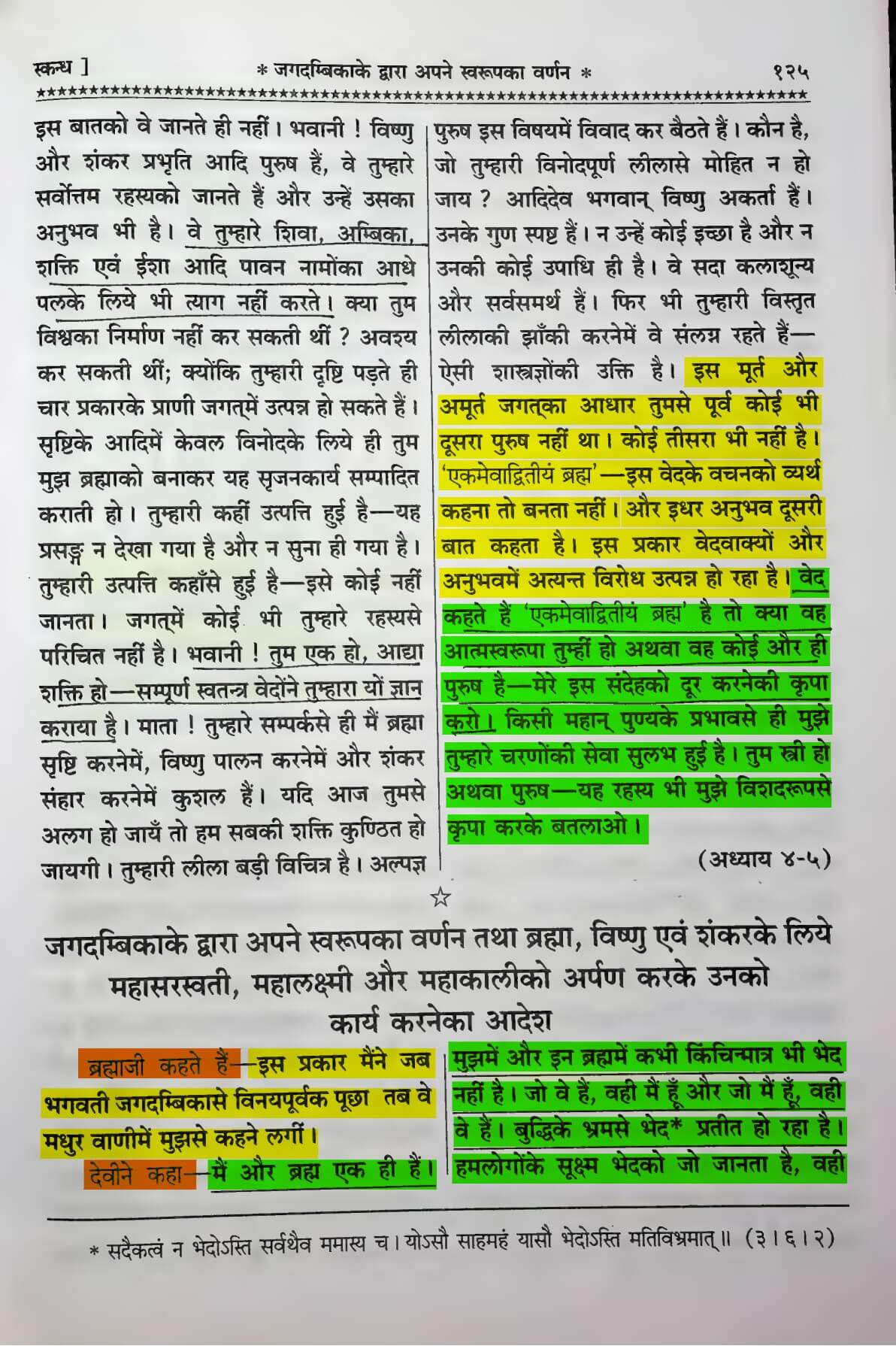
On shrimad-devi-bhagwat-page125.jpg, the Goddess answers by acknowledging their singular spiritual foundation:
"Devi ne kaha—Main aur Brahm ek hi hain. Mujhme aur is Brahm mein kabhi kinchinmatra bhi bhed nahi hai. Jo ve hain, vahi main hoon aur jo main hoon, vahi ve hain." (The Goddess said—I and Brahm are one and the same. There is not the slightest difference between me and this Brahm. What He is, I am; and what I am, He is.)
She deepens this explanation on shrimad-devi-bhagwat-page126.jpg by explaining that just as a single lamp appears to split into different shapes or functions based on external conditions (upadhi-bhed), she and Brahm are an inseparable essence that assumes a dual, split persona (dvaitarupa) purely to set the machinery of creation into motion. At this early stage, the identity of the Father is completely hidden behind her own front-facing divine persona.
Part 3: The Functional Shift — The Command to Remember "Both"
If they were unconditionally a single entity in every functional aspect, the Goddess would have concluded her instructions there. However, right before the Trimurti are sent away in their celestial aircraft to begin their planetary duties, the text introduces a deliberate, sharp division between the two beings.
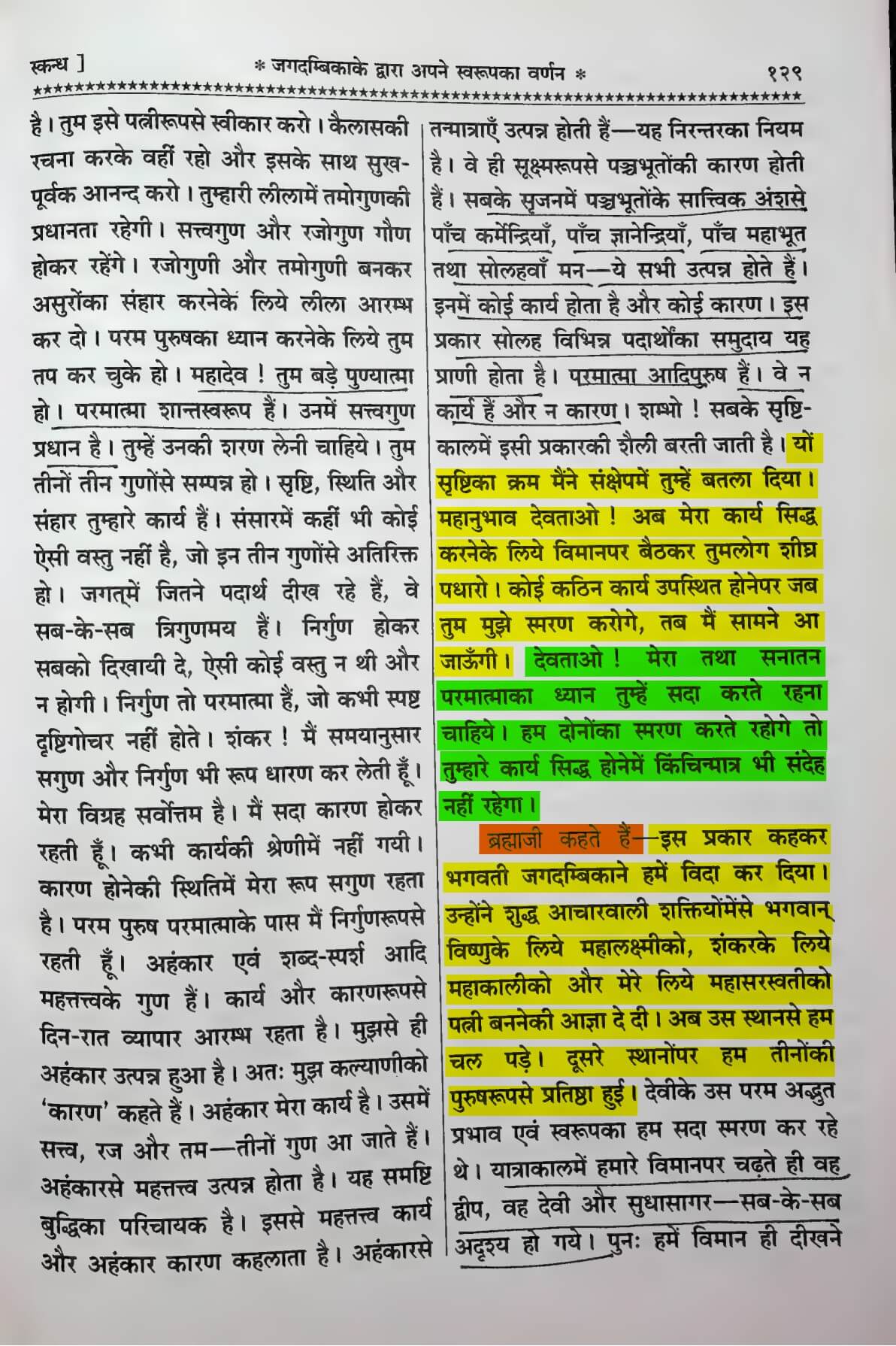
On shrimad-devi-bhagwat-page129.jpg, she explicitly treats Brahm as a distinct cosmic anchor and commands her sons to recognize and meditate upon both of them separately:
"Devataon! Mera tatha sanatan Parmatma ka dhyan tumhein sada karte rahana chahiye. Hum donon ka smaran karte rahoge..." (O Deities! You must always meditate upon me as well as the eternal Supreme Soul [Parmatma]. If you keep remembering both of us...)
By using the specific phrase "Hum Donon" (Both of us), she definitively shatters the illusion that there is only one entity to interact with. She forces the Trimurti to anchor their devotion to two separate pillars: the visible, manifest Mother (Goddess Durga) and their hidden, unmanifest Father (Sadashiva / Brahm).
Part 4: The Ultimate Proof — The Sermon to King Himalaya (7th Skanda)
While the Goddess drops subtle breadcrumbs of this duality to her children, she completely unveils the absolute, separate existence of this Supreme Brahm during her famous discourse to King Himalaya in the 7th Skanda. Here, she systematically separates herself from Brahm and points to Him as the ultimate destination of liberation.
1. Defining the Independent Form of "Akshar Brahm"
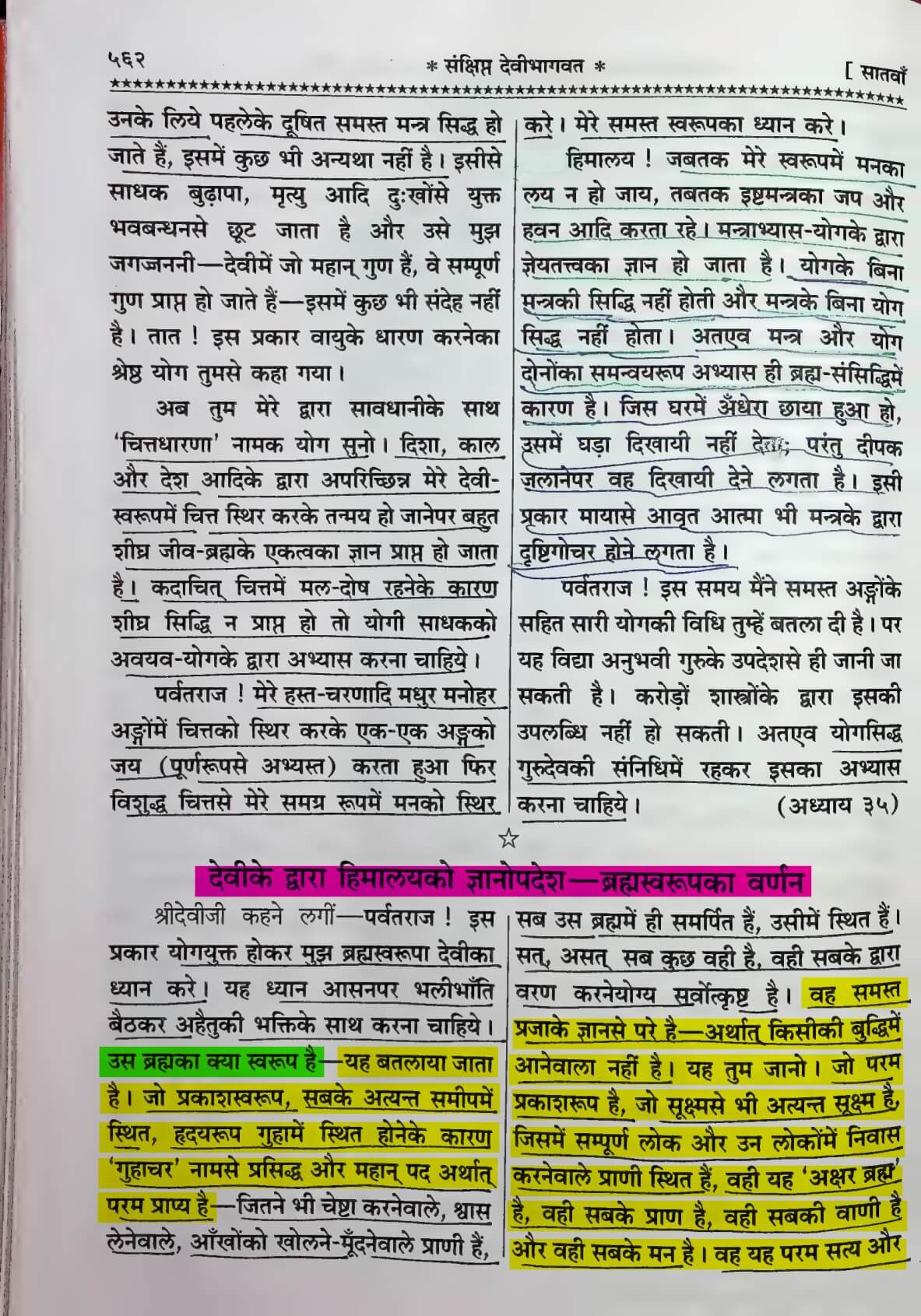
On shrimad-devi-bhagwat-page562.jpg, under the section "Devi ke dwara Himalaya ko Gyanopadesh—Brahmaswaroopa ka varnan", she speaks of Brahm as an entirely objective entity sitting in the grand cosmic sky:
"Jo prakashaswaroop, sabke atyant samrep mein sthit... vahi yeh 'Akshar Brahm' hai... vahi yeh sabka atma brahma brahmalookroop divya aakash mein sthit hai." (That which is the form of light, situated closest to everyone... that alone is this 'Akshar Brahm'... That soul of everyone, Brahm, is situated in the divine sky of Brahmaloka.)
2. The Target and the Weapon Metaphor
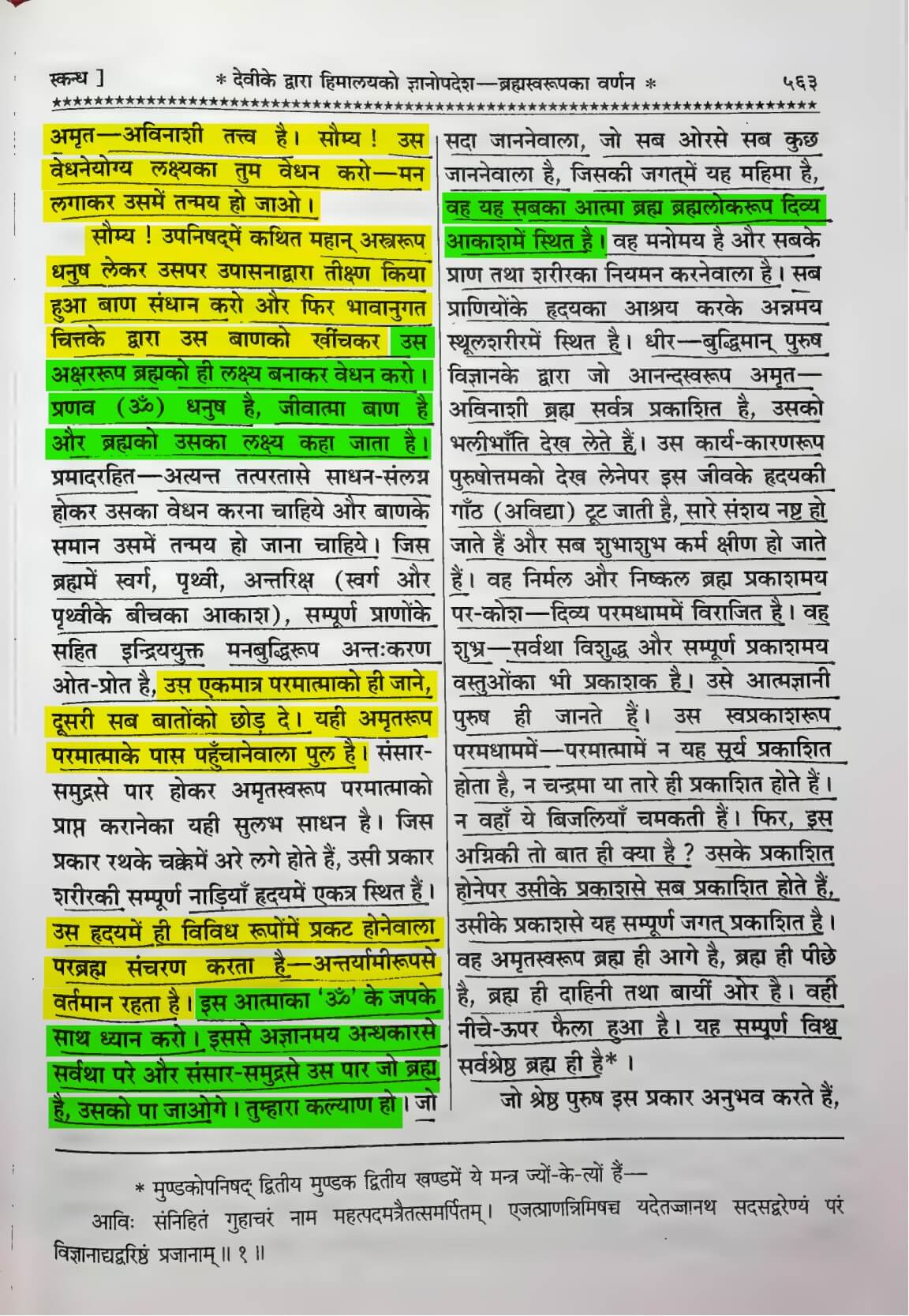
On shrimad-devi-bhagwat-page563.jpg, she explicitly removes herself from the equation of ultimate liberation, commanding the seeker to target Brahm independently using a brilliant bow-and-arrow metaphor:
- The Bow: Pranav (Om) is the bow.
- The Arrow: The Jivatma (individual soul) is the arrow.
- The Target: Brahm is the target (Lakshya).
She commands:
"Us akshar-roop brahma ko hi lakshya banakar vedhan karo... us ekmatra Parmatma ko hi jaane, doosri sab baaton ko chhod de." (Make that Akshar-form Brahm alone your target and pierce it... Know that one and only Supreme Soul, and leave all other talk aside.)
3. The Signature Mantra of Brahm: Om
To seal the fact that Brahm is a distinct entity requiring His own dedicated practice, she reveals His supreme syllable:
"Is atma ka 'Om' ke jap ke saath dhyan karo... sansar-samudra se us paar jo brahma hai, usko pa jaoge." (Meditate upon this Soul with the chanting of 'Om'... and you will cross the worldly ocean and attain that Brahm.)
⚡ Cross-Scriptural Duality Matrix
| Scriptural Stage | Source Text Definition | Practical Reality | Scriptural Source |
|---|---|---|---|
| Primal Separation | Sadashiva extracts Durga from His own body. | They become two separate beings (Husband & Wife / Father & Mother). | Shiva Purana (Rudra Samhita) |
| Philosophical Essence | "Main aur Brahm ek hi hain." | They share one identical essence, just like gold and a gold ornament. | shrimad-devi-bhagwat-page125.jpg |
| Direct Command to Trinity | "Mera tatha sanatan Parmatma ka... Hum donon ka smaran..." | The Trimurti are commanded to worship both separate entities. | shrimad-devi-bhagwat-page129.jpg |
| Direct Command to Seekers | "Brahm ko uska lakshya kaha jata hai... 'Om' ke jap ke saath dhyan karo." | Human souls must target Brahm separately using the unique mantra $mathbf{dddot{O}m}$. | shrimad-devi-bhagwat-page563.jpg |
Conclusion
By aligning the Shiva Purana with both the 3rd and 7th Skandas of the Shrimad Devi Bhagwat Purana, the ultimate identity confusion is completely cleared. Goddess Durga and Brahm are spiritually one in essence, but cosmically and structurally two separate beings.
The Goddess acts as the magnificent, front-facing manager of the cosmos, but she fiercely protects and points to the hidden reality of the Father, ensuring that all souls—from the high administrative Trimurti to human seekers—ultimately recognize and anchor themselves to that distinct, supreme unmanifest source via the sacred syllable Om
Evidence - Devi Bhagwat Puran
Page 125
Page 129
Page 562 - 563
पुराणों का सरल हिंदी रूपांतरण: दुर्गा और ब्रह्म — एक या दो अलग संस्थाएँ?
शिव पुराण और श्रीमद्देवीभागवत पुराण के 3रे और 7वें स्कंध के गहन अध्ययन से यह स्पष्ट होता है कि दुर्गा जी और ब्रह्म आध्यात्मिक रूप से 'एक' होने पर भी, वास्तविकता में दो 'अलग' सत्ताएँ हैं। इसका संपूर्ण विवरण इस प्रकार है:
१. मूल आधार: एक तत्व, दो स्वरूप (शिव पुराण)
- सृष्टि की शुरुआत: शिव पुराण के अनुसार, निराकार आदि पुरुष (भगवान सदाशिव/काल-ब्रह्म) ने अपनी दिव्य लीला के लिए अपने ही शरीर से एक परम नारी-शक्ति को अलग किया, जिन्हें दुर्गा, अम्बिका या प्रकृति कहा गया।
- रहस्य: चूंकि दुर्गा जी सीधे सदाशिव के शरीर से प्रकट हुईं, इसलिए दोनों का आत्मिक तत्व और ऊर्जा बिल्कुल एक समान (अभिन्न) है, परंतु प्रकट होने के बाद वे दो अलग-अलग अस्तित्व (पति-पत्नी या माता-पिता) के रूप में कार्य करते हैं।
२. प्रारंभिक भ्रम और दो संस्थाओं को याद रखने का आदेश (3रा स्कंध)
- "हम दोनों एक हैं": जब ब्रह्मा जी ने वेद वाक्य "एकमेवाद्वितीयं ब्रह्म" के बारे में पूछा, तो
shrimad-devi-bhagwat-page125.jpgपर माता दुर्गा ने उनके मूल तत्व की एकता को स्पष्ट करते हुए कहा—"मैं और ब्रह्म एक ही हैं। मुझमें और इस ब्रह्म में कभी किंचिन्मात्र भी भेद नहीं है।"shrimad-devi-bhagwat-page126.jpgपर वे समझाती हैं कि सृष्टि संचालन के लिए ही उन्होंने यह 'द्वैतरूप' (दो स्वरूप) धारण किया है। - "हम दोनों को याद रखना": यदि वे पूरी तरह से एक ही होतीं, तो बात यहीं खत्म हो जाती। लेकिन
shrimad-devi-bhagwat-page129.jpgपर त्रिदेवों को विदा करते समय माता दुर्गा ने स्पष्ट रूप से उन्हें दो अलग-अलग स्तंभों को पूजने का आदेश दिया—"हे देवताओं! मेरा तथा सनातन परमात्मा का ध्यान तुम्हें सदा करते रहना चाहिए। तुम हम दोनों का स्मरण करते रहोगे..."। यहाँ "हम दोनों" शब्द साफ करता है कि वे दो अलग सत्ताएँ हैं।
३. राजा हिमालय को ज्ञानोपदेश: ब्रह्म और दुर्गा का पूर्ण भेद (7वाँ स्कंध)
७वें स्कंध में माता दुर्गा इस रहस्य से पूरी तरह पर्दा उठा देती हैं और राजा हिमालय को समझाती हैं कि परम मोक्ष के लिए जीव को सीधे उस 'अक्षर ब्रह्म' को निशाना बनाना होगा:
- ब्रह्म की अलग स्थिति:
shrimad-devi-bhagwat-page562.jpgपर माता दुर्गा कहती हैं—"जो प्रकाशस्वरूप, सबके अत्यंत समीप स्थित... वही यह 'अक्षर ब्रह्म' है... वह यह सबका आत्मा ब्रह्म ब्रह्मलोकरूप दिव्य आकाश में स्थित है।" - धनुष-बाण का अकाट्य उदाहरण:
shrimad-devi-bhagwat-page563.jpgपर वे जीव को खुद को छोड़कर सीधे ब्रह्म पर ध्यान केंद्रित करने को कहती हैं: - धनुष: प्रणव (ॐ) धनुष है।
- बाण: जीवात्मा बाण है।
- निशाना/लक्ष्य: स्वयं 'ब्रह्म' ही वह लक्ष्य (लक्ष्य) है। वे आदेश देती हैं—"उस अक्षररूप ब्रह्म को ही लक्ष्य बनाकर वेधन करो... उस एकमात्र परमात्मा को ही जाने, दूसरी सब बातों को छोड़ दे।"
- ब्रह्म का मूल मंत्र (ॐ): माता दुर्गा स्पष्ट निर्देश देती हैं कि इस भवसागर से पार जाने के लिए उस ब्रह्म के मूल मंत्र का जाप करें—"इस आत्मा का 'ॐ' के जप के साथ ध्यान करो... संसार-समुद्र से उस पार जो ब्रह्म है, उसको पा जाओगे।"
⚡ शास्त्र-सम्मत तुलनात्मक तालिका (Scriptural Synthesis Matrix)
| सृष्टि और ज्ञान का चरण | शास्त्र की मूल परिभाषा (Literal Text) | त्रिदेवों और भक्तों के लिए वास्तविक स्थिति | प्रामाणिक स्रोत (Scans) |
|---|---|---|---|
| मूल विभाजन (Separation) | सदाशिव ने अपने शरीर से दुर्गा जी को अलग (प्रकट) किया। | आध्यात्मिक रूप से एक तत्व, लेकिन वास्तविकता में दो अलग दिव्य सत्ताएँ। | शिव पुराण (रुद्रसंहिता) |
| दार्शनिक सत्य (Essence) | "मैं और ब्रह्म एक ही हैं।" | जैसे सोने और सोने के आभूषण का तत्व एक ही होता है, वैसे ही दोनों का मूल एक है। | shrimad-devi-bhagwat-page125.jpg |
| त्रिदेवों को सीधा आदेश | "मेरा तथा सनातन परमात्मा का... हम दोनों का स्मरण..." | ब्रह्मा, विष्णु और शिव को दोनों को अलग-अलग याद रखने का निर्देश। | shrimad-devi-bhagwat-page129.jpg |
| मोक्ष का अंतिम मार्ग | "ब्रह्म को उसका लक्ष्य कहा जाता है... 'ॐ' के जप के साथ ध्यान करो।" | जीवात्मा को सीधे 'अक्षर ब्रह्म' को पाना है और उसका मंत्र 'ॐ' है। | shrimad-devi-bhagwat-page563.jpg |
निष्कर्ष: इन प्रमाणों से सिद्ध होता है कि लोक-कथाओं के विपरीत, माता दुर्गा और परमेश्वर ब्रह्म तत्व रूप में एक होकर भी दो अलग-अलग अस्तित्व हैं। दुर्गा जी इस सृष्टि की प्रत्यक्ष व्यवस्थापिका (Manager) हैं, जो स्वयं से परे स्थित अदृश्य पिता 'ब्रह्म' की ओर संकेत करती हैं और जीवों को उनके मूल मंत्र ॐ के माध्यम से उसी परम लक्ष्य को प्राप्त करने का उपदेश देती हैं।
Frequently Asked Questions (FAQs)
Q1: If Goddess Durga says "I and Brahm are one," why does she later treat Him as a separate entity?
- Answer: According to the Shiva Purana and Skanda 3 of the Shrimad Devi Bhagwat Purana, they are spiritually one in essence (sharing the same divine foundation) but cosmically two distinct beings in reality. The Goddess clarifies that they split into a dual form (dvaitarupa) purely to execute the machinery of universal creation, which is why she explicitly commands the Trimurti to meditate on both of them separately.
Q2: What is the meaning of the phrase "Hum Donon" used by the Goddess?
- Answer: On page 129 of the Shrimad Devi Bhagwat Purana, right before sending Brahma, Vishnu, and Shiva to perform their cosmic duties, the Goddess commands them to remember her as well as the eternal Supreme Soul (Sanatan Parmatma). By using the explicit words "Hum Donon" (Both of us), she conclusively establishes that they are two distinct cosmic anchors requiring individual recognition.
Q3: Where is the Supreme Brahm located according to the Goddess's sermon?
- Answer: In the 7th Skanda, while giving the sermon of supreme knowledge (Gyanopadesh) to King Himalaya on page 562, Goddess Durga states that this all-illuminating Akshar Brahm resides objectively in the grand cosmic sky known as Brahmaloka.
Q4: What is the specific metaphor the Goddess uses for achieving ultimate liberation?
- Answer: On page 563 of the Shrimad Devi Bhagwat Purana, she uses a classic Vedic bow-and-arrow metaphor. She defines the sacred syllable Pranav (Om) as the bow, the individual soul (Jivatma) as the arrow, and the independent Brahm as the absolute target (Lakshya) that must be pierced with undivided focus.
Q5: Is Om the mantra of Goddess Durga or Brahm?
- Answer: In her direct discourse on page 563, Goddess Durga explicitly reveals Om to be the signature mantra belonging to the Brahm. She instructs that by meditating upon the soul with the chanting of Om, a seeker will completely cross the ocean of worldly existence and directly attain that transcendent Brahm. (Gita 8.13 mentions this same Om mantra thus proving the speaker of Gita is Brahm)
◄ Shiva vs. Sadashiva The Puranic Multiverse: When the Trimurti Met Their Cosmic Duplicates ➤
